In any given month, the rising moon swings between two extremes on the eastern horizon, similar to the oscillation of the rising sun during the year. When the moon reaches its maximum northern or southern declination, it has a “standstill” similar to the sun at summer and winter solstices. The standstills could be said to be the moon’s equivalence to the Solar Solstices. [for details on lunar standstills, refer to Native American Skies: Lunar Standstills]
Showing posts with label archaeoastronomy. Show all posts
Thursday, March 5, 2015
Thursday, February 26, 2015
Native American Skies: Lunar Standstill at Chimney Rock
During the month, the moon rises at different points across the eastern horizon. When it reaches the farthest point north it pauses, or rises in the same spot for a couple of days, and then reverses course. This pause is called a “Lunar Standstill”. The same thing happens two weeks later at its farthest point south. You may have noticed that the sun does the same thing, but it takes the sun a year to move from its farthest point north (Summer Solstice) to its farthest point south (Winter Solstice) and back again. At each solstice, the sun pauses before reversing course and this is called a Solar Standstill.
[refer to last week’s article: Native American Skies: Lunar Standstill]
Friday, December 26, 2014
Native American Skies: Winter Solstice
The sky has been an important indicator of what is happening and what will happen on earth for ancient peoples all over the world for as long as man has possessed the curiosity to look up. The movement of the sun across the horizon and back throughout the year, has been especially important as an indicator and predictor of the seasons. On December 21st, 2014 the sun travelled as far south as it would go, rose for three days in the same place and then started its journey north again. That day marked the “Winter Solstice” (“Solstice” means “sun standstill”), the day with the longest night and shortest day of the year. The cultures of the Americas observed this very special day in many different ways, but for all, it was time of great portents. For what if the sun decided to continue its journey south?
Thursday, March 6, 2014
Native American Skies: Machu Picchu Obelisk
Sunday, March 2, 2014
Native Americans of the Northwest: Chinook Winds
My wife and I lived in Denver, Colorado for many years and occasionally experienced a phenomenon called the “Chinook Wind”. These winds, blowing over the Rocky Mountain Front Range, could actually raise the temperature from below freezing to 50 degrees Fahrenheit in just a few hours. Chinook winds can occur in many areas of western North America and certainly are not unique to Colorado. In fact, the term and the original Chinook winds originated in the northwestern coastal area.
The term “Chinook” comes from the Pacific Coast Chinook tribe that lived along the lower
Thursday, October 10, 2013
Native American Skies: The North Star
The ancients looked up to the sky and saw a reflection of the earth. It was a representation of all that was happening or had happened and provided understanding for those learned in interpreting the signs. When the ancients observed all of the sky revolving around the stationary North Star, of course, they saw it as significant. It represented the center of the cosmos.
![]() |
| Nahookos Bika and Nahookos Bi'aad father/hunter and mother/provider |
The Navajo call this important star, Nahookos Bikq (Na hoe kos Bih kwo) which means Central Fire. It is the cosmic center of the Navajo night sky and represents the central hearth, the fire, centered in the home or Hogan. And in the sky, it burns between the great father/hunter and great mother/provider constellations. (Note: Great Father is essentially the Big Dipper, Great Mother is the constellation Cassiopeia)
From “Sharing the Skies” by Nancy C. Maryboy and David Begay: “In Navajo culture, the central fire in a traditional Hogan has multiple values and therefore is extremely important. It provides stability for the family, as well as a sense of security and well-being. Nahookos Bikq provides warmth and tranquility as well as a focus, place, and means for ceremonial healing.”
![]() |
| the North Star changes over time due to precession |
Nahookos Bikq as observed by the ancient Navajo is in the same today. But, that tells us that this interpretation is fairly recent. Because of a slight wobble in the axis of earth—called “precession”—the polar north changes over time. Earth goes through one such complete precessional cycle in a period of approximately 26,000 years or 1° every 72 years, during which the positions of stars will slowly change. The Egyptians looking at their North Star in 2700 B.C. would not have been looking at Polaris. They would have been looking at the star “Thuban”. Today Thuban is several degrees away from center. In 1100 A.D. even Polaris was several degrees off center.
The cardinal directions were very important to the ancients. In the ancient Cherokee water ceremony
for cleansing, they paid tribute to seven directions—up, down, center, east, south, west, and north. In Chaco Canyon, the Great Kiva called Casa Rinconada is perfectly aligned with a north-south axis. Today, we might use the North Star to establish north. But, in 1100 A.D., when it was built, Polaris was 6-degrees from the pole. There are several methods they could have used, however. I think the most likely method was to mark the alignment during one of the solstices when the sun rises due east and sets due west. Another is the old Boy Scout method of placing a stick in the ground and marking the shadows at the sun progresses. The shortest shadow points north.
The Ancestral Puebloan, or Anasazi, were an agriculturally based society that build permanent homes and pretty much stayed in one place. They could build permanent astronomical markers to help them identify important dates using the sky. Nomadic tribes, however, could not. The Pawnee used a sky map painted on a buckskin. From “Living the Sky” by Ray A. Williamson:
“The north star, whose name in Pawnee is literally “the Star That Dows Not Walk Around,” they compared to the god Tirawahat. North Star was chief over all the other stars and saw to it that they did not lose their way. As depicted on the star chart, the north star is among the largest stars, and certainly much larger than those near it. This is directly contrary to the actual celestial appearance of the north star, which is fainter than, for example, several stars near it in Ursa Major [Big Dipper].”
On the chart, the “dippers” of the Big and Little Dippers represented stretchers and the “handles” represented the procession of mourners following. This came from a story told by the Pawnee about the council to decide where the gods would stand in the sky. Two members became sick and were carried on stretchers and still journey in the sky this way as a model to the Pawnee for caring for their sick.
Who knows at what point Polaris centered on the pole in the north enough to appear to “not walk around”. Even 500 years ago, a discerning observer could have seen it revolving around an empty space in the sky. We assume that ancient mariners used the north star for navigation, but it has only been used for the last 500 or 600 years. Before that, the sun or constellations were used in conjunction with a “cross-staff” or astrolabe. Before that, crude compasses were used but they were not very accurate. Before that, they hugged the shoreline and used line of sight to navigate. To me it is a striking example of how times change and people adapt.
by Courtney Miller
Thursday, October 3, 2013
Native American Skies: The Milky Way
Well, its October! According to an old Navajo tradition, we can now (October thru February) go into the Hogan a speak about the night sky. “The time of winter stories is considered to be a time of sharing and reflection when bears, reptiles, and insects are hibernating, and while plants are regenerating their potency for their next life cycle in the spring.” [Nancy C. Maryboy, David Begay, “Sharing the Skies, Navajo Astronomy”] This time of teaching ends with the first sound of Thunder ushering in spring.
![]() |
| Navajo Hogan |
Today it is hard for us to understand why the night sky and the sun cycles were so important to ancient cultures. If we need to know the time, we look at our watch. If we need to know what day it is, we look at our calendars. We are told when spring begins by TV broadcasters or by notices from local department stores advertising their spring sale. Most of the population in the “civilized” world can’t see half the night sky for the light dome over the city they live in. Today the night sky and the stories related to the stars, constellations, and planets are just a novelty.
| Starry Night software on laptop showing Milky Way aligned along pre-dawn horizon |
But in ancient times, understanding the movements and related stories of the night sky and sun cycles were as critical as understanding the computer is to us today. It was, in a way, their computer or their internet. The answers to all of life’s questions resided in the sky, if you knew how to read it.
This doesn’t just apply to Native Americans, it applies to all ancient cultures. For most of us, what we know about the constellations and movements in the sky came from the Greek astronomers who learned from the Summerians and Babylonians who learned from the Egyptians, etc. “Western” cosmology is a hodge-podge of multicultural stories, legends and myths. Most have lost their meaning and significance over the ages.
Dr. John J. Boucek, in his article for the Wet Mountain Tribune, observed, “It is an amazing fact that ancient cultures, though continents apart, have viewed the Milky Way and philosophized along similar lines as to its significance.“The ancient Greeks titled it ‘that spinning wheel which men called Galaxios,’ the name being derived from the Greek gala or galactos, which simply means milk. Hence the Latin term Via Galactica or Milky Way.
“A half dozen more Chinese poets, some from the pre-Confucian era refer to the Milky Way in similar terms, calling it the ‘Celestial River’ or the Han River, sometimes regarded as the ultimate source of the earthly Yellow River of central China.
“In American Indian legend, it is the path to the hereafter. The Algonquins saw the campfires of their departed warriors in the bright stars along the way.
“The Norsemen saw the Milky Way as the path of their warriors on their way to Valhalla.”
In Hindu mythology the Milky Way was churned by means of a serpent to acquire the nectar of life.
I would add the old Cherokee Story that attributes the Milky Way to the trail of a naughty dog that got into the corn meal and tracked it across the sky.
The Navajo name for the Milky Way is Yikaisdaha which means “That Which Awaits the Dawn”. The Navajo observed that there is only one time during the year when Yikaisdaha aligns perfectly with the horizon. That time is in January just before dawn. Amazingly, it aligns with the entire predawn horizon.
What is interesting to me is that at the base of the cosmological systems is the belief that the sky is a reflection of what is happening or has happened or will happen on earth. So, each culture looks up and sees those things or events that are important to their particular culture. The Olmec and Mayan astronomers watched and recorded the skies for thousands of years and came to the conclusion that all things have a cycle and if you follow events long enough, they will repeat. This is very powerful because that means that if you learn the cycle, you can predict the future because it will repeat!
-- Courtney Miller
Thursday, February 7, 2013
The Sangre de Cristo Solar Calendar
My house sits on a round hill in the foothills of the Wet Mountains. This hill is the last vestige of the Wet Mountains and looks out over the Wet Mountain valley. Across the long, narrow valley, the majestic Sangre de Cristo Mountains rise up with many peaks topping 14,000 feet. The Sangre de Cristo is the longest, continuous mountain range in the Rocky Mountains and stretches from the Arkansas River to the north down to Santa Fe, New Mexico in the south.
![]() |
| Summer Solstice Equinox sets between 2nd and 3rd peak from left |
If I had lived on this spot 1,000 years ago, The Wet Mountains to my east and Sangre de Cristos to the west would have provided me the most perfect solar calendar to track my days, months, and seasons. All I would have to do is note where the sun rises and where it sets each day for a year and then I would be able to predict the longest day of the year (first day of summer), the shortest day of the year (first day of winter) and the day when night and day are equal (first day of spring and first day of autumn). Why would I care? Because planting at the right time is critical. Knowing when winter is coming is critical.
| Sunset the day before my father's birthday |
Every year for Christmas, my sister creates a calendar for me on her computer that notes everyone’s birthday and the holidays. That calendar sits on my desk and I use it to remember birthdays, plan vacations, observe the holidays, etc. What would I do without my calendar? Well, 1,000 years ago, the rising and setting sun would have been my calendar. Over time, I would come to know that when the sun sets between Crestone Needles and Crestone Peak, it is September 20th, the vernal equinox, the beginning of Autumn. And when the sun sets in the saddle of Marble Mountain, I had better send my sister a birthday card!
| Winter Solstice Equinox would set on mountain above the "6" |
I would know that as the sun continuously set further and further south, the days would grow shorter and shorter and it would get progressively colder. My greatest fear might be that it would never stop traveling south and one day there would be no more days, just night! So, around December 20th when the sun sets in the same spot for several days in a row and then starts travelling back to the north, that would be a most significant time and I would want to celebrate – Christmas maybe?
Today, I can take a picture of the sunset and my digital camera will imprint the date down in the bottom right corner of the picture. Then next year, when the sun sets there again, I can take out my picture and say, “Today is ________”! The picture to the right is sunrise near the Equinox, note how the shadow points to the spot where the sun will set that evening.
Well, pre-historic Native Americans (all ancient cultures, for that matter) didn’t have digital cameras so they had to come up with their own methods for remembering the days and following their calendars. The Plains Indians, for instance, created medicine wheels (see below) that enabled them to line up the sun in alignment with stones they had placed the year(s) before. The Anasazi built great stone buildings with significant alignments. At Casa Rincanada, a giant Anasazi kiva, on the equinox, the sun would shine through a small window on the east side of the kiva and light up a small, square cache in the west wall. At Stonehenge, on the summer solstice, the sun would shine through two pillars and illuminate an alter in the center of the circle of stones.

For as long as man has had the intelligence to watch the sun and stars, he has used this information to help him plan his days. And, as we know, man is a most creative and imaginative being. I think this is why I enjoy “Archaeoastronomy”, the study of how the ancients used astronomy, so much and why so many articles in Native American Antiquity are devoted to this subject.
Well, gotta go, the sun is about to rise and I need to run grab a picture of it!-- Courtney Miller
Thursday, November 15, 2012
Archaeoastronomy -- Fajada Butte -- Sun Daggers
First of all, what is archaeoastronomy? It is the study of how the ancients studied or used astronomy. The position of the stars in the night sky; the movement of the sun across the horizon throughout the year; the movement of the Moon across the horizon on its eighteen-nineteen year cycle; were all studied and recorded and used by the ancients as their celestial calendar. Knowledge of these cycles helped the ancients to know when to plant their crops, or migrate, celebrate their religious holidays, and many other important events during the year.
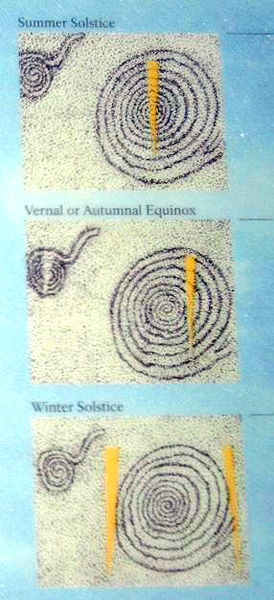
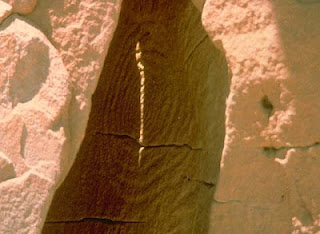
In the heart of New Mexico there is an arid canyon called Chaco Canyon that was once the center of the Anasazi culture. In this canyon stands an ominous butte called Fajada (fa-ha-da) Butte. Atop this huge 450 ft-high formation are three large sandstone slabs that lean up against the southern wall. On the wall behind these huge stones, the Anasazi astronomers chiseled two large spirals. At noon every day the sun shines between the stones and casts shaft(s) of light across the spirals. Popularly called “daggers of light”, the dagger materialize before noon in the upper left of the spiral and then spread across the spiral to project a “dagger” covering the spiral and then clears off the spiral top to bottom. It is an amazing, almost magical occurrence.
![]() |
| Click for video of Sun Dagger |
The Sun Dagger phenomenon was first noticed by artist Anna Sofaer in 1977 when she was a volunteer recording the petroglyphs on Fajada Butte. On her first visit, she noted the three stone slabs leaning against the cliff in front of two spiral petroglyphs on the cliff wall. On her second visit, she happened to be at the site around 11 a.m. and witnessed the dagger of light bisecting one of the spirals. An amazing stroke of luck since the dagger only appears for about 18 minutes each day. Realizing that the summer solstice was imminent, she correctly recognized the site as an important archaeoastronomical site.
The following year, she founded the “Solstice Project” to focus on the study, documentation and preservation of the Sun Dagger site. Her team learned that for the spring equinox, two daggers appear. A smaller dagger bisects a smaller spiral through its center, whereas the larger dagger pierces the larger spiral off center. For the summer solstice, the larger spiral is bisected by a larger dagger through its center. The autumn equinox is the same as the spring equinox. Then for the winter solstice, two large daggers embrace the sides of the larger spiral like bookends. Even more remarkable, it was observed that the 19 segments of the larger spiral marked the 19 year movement of the moon from minimum to maximum across the horizon.
At the Archaeoastronomical Symposium at Queen’s College, September, 1981, Anna Sofaer submitted a paper on her work . It was the conclusion of the symposium that the Sundagger Site is the only known site in the world where both the solar and lunar extremes are marked.
For over one thousand years, the stone slabs produced a dagger of light to mark the solar extremes and marked the lunar shadow marching through its 19 year extremes. Its rediscovery generated so much interest that the many visitors eager to observe the site first-hand tramped down the soil next to the slabs prompting the site to be restricted and not even the park staff are allowed to visit the Sun Dagger site today. Unfortunately, the damage was fatal and caused the slabs to shift. As a result, the slabs no longer produce the daggers of light as they once did. The restriction was placed too late to save it.
Thursday, September 6, 2012
Inconvenient Arrogance -- Part 2
When men are most sure and arrogant they are commonly most mistaken, giving views to passion without that proper deliberation which alone can secure them from the grossest absurdities.
-- David Hume
The Power of the Astronomer
Today, astronomy is just one of the sciences and most people are, at best, fascinated by the night sky and the advancing sun and moon. But throughout ancient times, the astronomer was critical to agricultural societies. Someone had to watch the sunrises and sunsets, or the changing star patterns, or the moon cycles to determine the seasons for planting and harvesting.
Different cultures developed very sophisticated methods for tracking these phenomena. And it appears that as the astronomers got better at their craft, they also acquired more and more importance, and, therefore, more and more power in the society.
There was a pattern. At first, the astronomer(s) earned their keep in the community and they basically provided calendric information. Initially, it was the planting seasons, then the timing for ritual celebrations. Over time, their function branched out and they began to study weather patterns and gained skills in prediction. And, finally, the step that man seeks in all of his activities – control. The ability to not only predict the weather but determine the weather – cause it to rain, etc. Most societies recognized a greater force controlling climate – God or gods, spirits. The astronomy class gained great power by being able to connect and communicate with the higher forces and eventually, influence the gods. It elevated the astronomer/priests, in some cases, to the level of gods.
Over time, with the climate stable and year-after-year of the same weather cycles, the credit for the stability shifted to the astronomer/priests. And the leaders were credited for the successful crops and the bountiful harvests and the glorious way of life created.
But, of course, climate invariably changes. And when the astronomer/priests were unable to stop the change or correct the droughts or bring on rain, they faced a huge dilemma and the threat of losing their place in the society. So, when they failed to influence the gods, they blamed the society itself for offending the gods by their offensive actions. Society had offended the gods and must make amends. Greater and greater penances had to be paid to “right the wrong” and gain back the favor of the gods.
In many societies, it was even human sacrifices. In some cases, captured enemies were sacrificed to appease the gods. In some cases, the most precious of all assets in the community, the virgins were sacrificed. When, in the end and over time, it was proven that, alas, the priests did not have control of the elements, or influence over the gods, often the entire society failed. The grand cities and temples built by the arrogant leaders and priests were abandoned or destroyed and the leaders and priests vanquished.
Continue to Part 3
-- Courtney Miller
-- David Hume
The Power of the Astronomer
![]() |
| Mayan Observatory |
Different cultures developed very sophisticated methods for tracking these phenomena. And it appears that as the astronomers got better at their craft, they also acquired more and more importance, and, therefore, more and more power in the society.
![]() |
| Fajada Butte, Chaco Canyon, NM Anasazi Observatory |
![]() |
| Sun Dagger marking the summer solstice Atop Fajada Butte http://www.colorado.edu/Conferences/chaco/tour/fajada.htm |
There was a pattern. At first, the astronomer(s) earned their keep in the community and they basically provided calendric information. Initially, it was the planting seasons, then the timing for ritual celebrations. Over time, their function branched out and they began to study weather patterns and gained skills in prediction. And, finally, the step that man seeks in all of his activities – control. The ability to not only predict the weather but determine the weather – cause it to rain, etc. Most societies recognized a greater force controlling climate – God or gods, spirits. The astronomy class gained great power by being able to connect and communicate with the higher forces and eventually, influence the gods. It elevated the astronomer/priests, in some cases, to the level of gods.
Over time, with the climate stable and year-after-year of the same weather cycles, the credit for the stability shifted to the astronomer/priests. And the leaders were credited for the successful crops and the bountiful harvests and the glorious way of life created.
But, of course, climate invariably changes. And when the astronomer/priests were unable to stop the change or correct the droughts or bring on rain, they faced a huge dilemma and the threat of losing their place in the society. So, when they failed to influence the gods, they blamed the society itself for offending the gods by their offensive actions. Society had offended the gods and must make amends. Greater and greater penances had to be paid to “right the wrong” and gain back the favor of the gods.
In many societies, it was even human sacrifices. In some cases, captured enemies were sacrificed to appease the gods. In some cases, the most precious of all assets in the community, the virgins were sacrificed. When, in the end and over time, it was proven that, alas, the priests did not have control of the elements, or influence over the gods, often the entire society failed. The grand cities and temples built by the arrogant leaders and priests were abandoned or destroyed and the leaders and priests vanquished.
Continue to Part 3
-- Courtney Miller
Friday, June 29, 2012
July 4th, 1054!

On July 4, 1054, in ancient China, a Chinese astronomer noticed an amazing thing! A Star bright enough to be seen in broad daylight! He recorded the event calling the mysterious star a “Guest Star”. He noted that it was four times brighter than Venus. After about 23 days, the star moved to the night sky and was noted by astronomers in Arabia, Japan, and even here in America.The native American astronomer, an Anasazi living in Chaco Canyon, noted his discovery by painting the star and its position related to the crescent moon on the underside of a cliff shelf. He even signed his drawing with his hand print. The petroglyph can still be seen below West Mesa in Chaco Canyon, just outside the great house called PeƱasco Blanco.
Out of curiousity, I ran my astronomy program “Starry Night” and set the date back to 1054. I let the program sequence through the night sky starting July 4th. What I found was that the star (we know it today as M1, the Crab Nebula) was indeed in the day sky at first. Later it progressed to the night sky. Below is a screen print from my Starry Night program showing the Crab Nebula approaching the moon. Compare its position to the moon compared to the petroglyph!
Over time, the star dimmed until it was just a faint fuzzy spot in the constellation Tauras.
The object was rediscovered in 1731 by John Bevis who added it to his sky atlas, Uranographia Britannica. In 1758, the astronomer, Charles Messier, independantly discovered it again. Only, Messier was very disappointed with his discovery. Messier was looking for the comet Haley that was predicted to return. When he spotted the fuzzy object in the vicinity of where he expected to find the comet, he assumed he had found a comet! When the fuzzy object did not move after observing for several days, he knew that it was not a comet but a nebula. Frustrated, he declared that there should be a “catalog” of known objects so that astronomers would not have to continue to “rediscover” them. The fuzzy nebula became “M1” in Messier’s now famous catalog. Messier later learned of Bevis’ discovery and gave him credit in a letter. Ironically, M1 was again confused with Haley’s second predicted return.
So what was the bright star of 1054? It was the first recorded “Super Nova”! “Super Nova” is the term given to the event of a star exploding! When it first exploded, it was extremely bright. But as the debris separated, it became dimmer and dimmer. J.C. Duncan of Mt. Wilson Observatory compared photographic plates taken 11.5 years apart, and found that the Crab Nebula was expanding at an average of about 0.2" per year. Backtracing of this motion showed that this expansion must have begun about 900 years ago. Simultaneously, Knut Lundmark, with the Astronomical Society, noted the proximity of the nebula to the 1054 supernova.
If the picture doesn’t remind you of a crab, you’re not the only one. It was christened the “Crab Nebula” based on drawings made by Lord Rosse in 1844. Want to see it for yourself? You will need a good pair of binoculars (10X50 or better). The nebula is located in the horn of the constellation of Tauras. Go to http://www.telescopes.com/findcrabnebula_lp.cfm for steps to help you find it.
Subscribe to:
Posts (Atom)


