Showing posts with label astronomy. Show all posts

Thursday, March 26, 2015

Dark Skies in Westcliffe/Silvercliff

For many centuries, dark skies filled with billions of twinkling stars was taken as a matter of fact.  Shepherds, nomads, farmers and travelers used the sky to guide them and teach them.  The movements and cycles of the heavens were well-known and closely observed by all.  But, as populations have grown, first candle light and now electric lights have slowly started to block out the night sky with their light domes.
Until recently, there were only eight places in the world “certified” as “Dark Sky Communities” by the International Dark-Skies Association headquartered in Tucson, Arizona.  They are:
  • Flagstaff, Arizona
  • Borregos Springs, California
  • Isle of Sark, Channel Islands
  • Homer Glen, Illinois
  • Isle of Coll, Scotland
  • Dripping Springs, Texas
  • Beverly Shores, Indiana
  • Sedona, Arizona

Friday, December 26, 2014

Native American Skies: Winter Solstice

The sky has been an important indicator of what is happening and what will happen on earth for ancient peoples all over the world for as long as man has possessed the curiosity to look up.  The movement of the sun across the horizon and back throughout the year, has been especially important as an indicator and predictor of the seasons.  On December 21st, 2014 the sun travelled as far south as it would go, rose for three days in the same place and then started its journey north again.  That day marked the “Winter Solstice” (“Solstice” means “sun standstill”), the day with the longest night and shortest day of the year.    The cultures of the Americas observed this very special day in many different ways, but for all, it was time of great portents.  For what if the sun decided to continue its journey south?
 

Thursday, October 3, 2013

Native American Skies: The Milky Way

Well, its October!  According to an old Navajo tradition, we can now (October thru February) go into the Hogan a speak  about the night sky.   “The time of winter stories is considered to be a time of sharing and reflection when bears, reptiles, and insects are hibernating, and while plants are regenerating their potency for their next life cycle in the spring.” [Nancy C. Maryboy, David Begay, “Sharing the Skies, Navajo Astronomy”]  This time of teaching ends with the first sound of Thunder ushering in spring.
 
Navajo Hogan

Today it is hard for us to understand why the night sky and the sun cycles were so important to ancient cultures.  If we need to know the time, we look at our watch.  If we need to know what day it is, we look at our calendars.  We are told when spring begins by TV broadcasters or by notices from local department stores advertising their spring sale.  Most of the population in the “civilized” world can’t see half the night sky for the light dome over the city they live in.  Today the night sky and the stories related to the stars, constellations, and planets are just a novelty.

 
Starry Night software on laptop showing
Milky Way aligned along pre-dawn horizon
But in ancient times, understanding the movements and related stories of the night sky and sun cycles were as critical as understanding the computer is to us today.  It was, in a way, their computer or their internet.  The answers to all of life’s questions resided in the sky, if you knew how to read it.

This doesn’t just apply to Native Americans, it applies to all ancient cultures.  For most of us, what we know about the constellations and movements in the sky came from the Greek astronomers who learned from the Summerians and Babylonians who learned from the Egyptians, etc.   “Western” cosmology is a hodge-podge of multicultural stories, legends and myths.  Most have lost their meaning and significance over the ages.


Dr. John J. Boucek, in his article for the Wet Mountain Tribune, observed, “It is an amazing fact that ancient cultures, though continents apart, have viewed the Milky Way and philosophized along similar lines as to its significance.

“The ancient Greeks titled it ‘that spinning wheel which men called Galaxios,’ the name being derived from the Greek gala or galactos, which simply means milk.  Hence the Latin term Via Galactica or Milky Way.

“A half dozen more Chinese poets, some from the pre-Confucian era refer to the Milky Way in similar terms, calling it the ‘Celestial River’ or the Han River, sometimes regarded as the ultimate source of the earthly Yellow River of central China.

“In American Indian legend, it is the path to the hereafter.  The Algonquins saw the campfires of their departed warriors in the bright stars along the way.

“The Norsemen saw the Milky Way as the path of their warriors on their way to Valhalla.”
 
In Hindu mythology the Milky Way was churned by means of a serpent to acquire the nectar of life.

I would add the old Cherokee Story that attributes the Milky Way to the trail of a naughty dog that got into the corn meal and tracked it across the sky.

The Navajo name for the Milky Way is Yikaisdaha which means “That Which Awaits the Dawn”.   The Navajo observed that there is only one time during the year when Yikaisdaha aligns perfectly with the horizon.  That time is in January just before dawn.  Amazingly, it aligns with the entire predawn horizon.

What is interesting to me is that at the base of the cosmological systems is the belief that the sky is a reflection of what is happening or has happened or will happen on earth.  So, each culture looks up and sees those things or events that are important to their particular culture.  The Olmec and Mayan astronomers watched and recorded the skies for thousands of years and came to the conclusion that all things have a cycle and if you follow events long enough, they will repeat.  This is very powerful because that means that if you learn the cycle, you can predict the future because it will repeat!
 
 
-- Courtney Miller

Thursday, September 6, 2012

Inconvenient Arrogance -- Part 2

When men are most sure and arrogant they are commonly most mistaken, giving views to passion without that proper deliberation which alone can secure them from the grossest absurdities.
-- David Hume


The Power of the Astronomer


Mayan Observatory
Today, astronomy is just one of the sciences and most people are, at best, fascinated by the night sky and the advancing sun and moon.  But throughout ancient times, the astronomer was critical to agricultural societies.  Someone had to watch the sunrises and sunsets, or the changing star patterns, or the moon cycles to determine the seasons for planting and harvesting.

Different cultures developed very sophisticated methods for tracking these phenomena.  And it appears that as the astronomers got better at their craft, they also acquired more and more importance, and, therefore, more and more power in the society. 
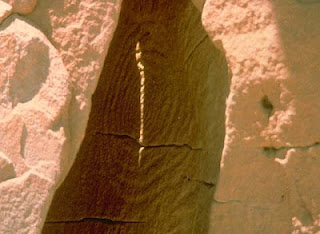
Fajada Butte, Chaco Canyon, NM
Anasazi Observatory


Sun Dagger marking the summer solstice
Atop Fajada Butte
http://www.colorado.edu/Conferences/chaco/tour/fajada.htm

There was a pattern.  At first, the astronomer(s) earned their keep in the community and they basically provided calendric information.  Initially, it was the planting seasons, then the timing for ritual celebrations.  Over time, their function branched out and they began to study weather patterns and gained skills in prediction.  And, finally, the step that man seeks in all of his activities – control.  The ability to not only predict the weather but determine the weather – cause it to rain, etc.  Most societies recognized a greater force controlling climate – God or gods, spirits.  The astronomy class gained great power by being able to connect and communicate with the higher forces and eventually, influence the gods.  It elevated the astronomer/priests, in some cases, to the level of gods.
Over time, with the climate stable and year-after-year of the same weather cycles, the credit for the stability shifted to the astronomer/priests.  And the leaders were credited for the successful crops and the bountiful harvests and the glorious way of life created.

But, of course, climate invariably changes.  And when the astronomer/priests were unable to stop the change or correct the droughts or bring on rain, they faced a huge dilemma and the threat of losing their place in the society.  So, when they failed to influence the gods, they blamed the society itself for offending the gods by their offensive actions.  Society had offended the gods and must make amends.  Greater and greater penances had to be paid to “right the wrong” and gain back the favor of the gods.

In many societies, it was even human sacrifices.  In some cases, captured enemies were sacrificed to appease the gods.  In some cases, the most precious of all assets in the community, the virgins were sacrificed.  When, in the end and over time, it was proven that, alas, the priests did not have control of the elements, or influence over the gods, often the entire society failed.  The grand cities and temples built by the arrogant leaders and priests were abandoned or destroyed and the leaders and priests vanquished.

Continue to Part 3

-- Courtney Miller