Thursday, March 28, 2013

2 - Incidents of Travel: Mayan Ruins


Part 2: Uxmal, featuring incidents of Travel by Rhondda Hartman


John Lloyd Stephens 1836

The last city visited by John Lloyd Stephens and Frederick Catherwood in their monumental trip to Central America in 1839 and the first site revisited on their return was Uxmal.  Stephens described the ruins as follows:

“The hacienda of Uxmal was built of dark gray stone, ruder in appearance than any of the others [cities visited].  … In the afternoon, [I] set out for a walk to the ruins.  The path led through a noble piece of woods, in which there were many tracks, and [my] Indian guide lost his way.  We took another road, and, emerging suddenly from the woods, to my astonishment came at once upon a large open field strewed with mounds of ruins, and vast buildings on terraces, and pyramidal structures, grand and in good preservation, richly ornamented, without a bush to obstruct the view, and in picturesque effect almost equal to the ruins of Thebes.
Uxmal by Frederick Catherwood

“The place of which I am now speaking was beyond all doubt once a large, populous, and highly civilized city.  Who built it, why it was located away from water or any of those natural advantages which have determined the sites of cities whose histories are known, what led to its abandonment and destruction, no man can tell.


Uxmal today
“… The first object that arrests the eye on emerging from the forest is the building [House of the Dwarf, see below].  From its front doorway I counted sixteen elevations, with broken walls and mounds of stones, and vast, magnificent edifices, which seemed untouched by time.

“… The other building is called Casa de las Monjas, or House of the Nuns, or the Convent.  It is situated on an artificial elevation about fifteen feet high.  Its form is quadrangular, and one side, according to my measurement, is ninety-five paces in length.  … Like the House of the Dwarf, it is built entirely of cut stone, and the whole exterior is filled with the same rich, elaborate, and incomprehensible sculptured ornaments.”


Uxmal "The Nunnery"
“While I was making the circuit of these ruins, Mr. Catherwood proceeded to the Casa del Gobernador.  It is the grandest in position, the most stately in architecture and proportions, and the most perfect in preservation of all the structures remaining at Uxmal. … There is no rudeness or barbarity in the design or proportions; on the contrary, the whole wears an air of architectural symmetry and grandeur; and as the stranger ascends the steps and casts a bewildered eye along its open and desolate doors, it is hard to believe that he sees before him the work of a race in whose epitaph, as written by historians, they are called ignorant of art, and said to have perished in the rudeness of savage life.  If it stood at this day on its grand artificial terrace in Hyde Park or the Garden of the Tuileries, it would form a new order, I do not say equaling, but not unworthy to stand side by side with the remains of Egyptian, Grecian, and Roman art.”

Compare Stephen’s  impression of Uxmal to this visit by Rhondda Hartman:
 
Rhondda Hartman
“We went in the early 1970s and took our 2 oldest girls with us; they were about 12 & 14.  Uxmal is the most delightful of all the pyramids I have visited, and the first.   It is 'soft' and architecturally beautiful with its rounded walls and elliptical shape.   I would call it a boutique archaeological site! Chichen Itsa, by comparison, is harsh and sharp and a military compound.   Uxmal is more like a palace.
  
“My belief is that the sacrificial rituals that are attributed to the Mayans were introduced by other civilizations of Toltec and Aztec!   As in Chichen Itsa,  Mayans are a peaceful culture, I think, at least Uxmal feels that way to me!  We were on a tour and our hotel was nearby.  One of my daughters and I could not wait for the guide.  We went on our own and climbed all over the pyramid and surrounding areas and felt so comfortable.   [House of the Dwarf pictured below]
 
“We also joined the tour at the established time, but when that was done, we wandered off by ourselves again and found the un-restored area of the park.  A kind worker saw our interest and gave us a tour of the jungle-covered part of the Mayan city and outside the walls where the commoners lived.  We were so comfortable and felt as though it was familiar territory for us. We seemed to know where we were and where to go!  Well, do I need to tell you that it sparked an interest in the Mayan civilization for both of us?  And you can be sure that if there is reincarnation, my daughter and I lived there!
 
“It was about that time that I went to UCD to get a Masters and I took several courses on the culture.  I have an interest in a trip to see the more important Mayan cities of Tikal , Palenque , Copan and Bonampak.  I cannot revisit Uxmal since the first time was so magical I could probably never achieve that experience again!”

-- Rhondda Hartman is an expert on natural childbirth, renowned speaker and is the author of “Exercises For True Natural Childbirth”.  Rhondda has travelled all over the world and says that one of her favorite places in the world is Uxmal.
 
Have you travelled to see the Mayan ruins? I would like to hear your story. If you are willing to share your story, please submit it by clicking here. Throughout this series, I will be posting stories from readers and comparing their experiences with those of Stephens and Catherwood.


Thursday, March 21, 2013

1 - Incidents of Travel: Maya Ruins


Part 1: John Lloyd Stephens and Frederick Catherwood


John Lloyd Stephens
 On a dark night in October, 1839, a wealthy attorney from New York and an architect from England, set sail on an adventure that they could not have imagined.   The attorney, John Lloyd Stephens, had made his wealth as an author profiting from a trip to Europe for “health reasons”.   He had acquired a “persistent streptococci throat” while politicking for Andrew Jackson.   His doctor recommended a trip to Europe.  While in Europe, he sent articles on “incidents of travel’ back to his friend at the American Monthly magazine which were quite successful.  The influx of immigrants to America flooded all means of transport back home, so Stephens extended his travels to Egypt, Arabia, the Holy Lands, Petra, Turkey, Russia, Poland and eventually England.  While visiting Jerusalem, he met Frederick Catherwood, an English architect trying to make a living drawing the ruins of Rome and sketching the architecture of the Holy Lands.  Stephens purchased a map of the Holy Lands drawn by Catherwood and was so impressed by it that he later looked up Catherwood in England.  They became great friends.
 
Frederick Catherwood
self-portrait
Back in New York, Stephens compiled his notes and “Incidents of Travel in Egypt, Arabia Petraea, and the Holy Land” was published in 1837.  It was wildly successful and was followed up by “Incidents of Travel in Greece, Turkey, Russia, and Poland” setting up Stephens financially.   
Rumors of great cities in Central America were floating about and Stephens enlisted his friend Catherwood, who had relocated to New York, to join him for a trip to Central America.  Stephens described his friend as, “… an experienced traveler and personal friend, who had passed more than ten years of his life in diligently studying the antiquities of the Old World; and whom, as one familiar with the remains of ancient architectural greatness …”
At that time, only three archaeological sites were known in Central America – Copan, Palenque, and Uxmal.  No one connected the cities with any known culture and the name “Maya” was scarcely known.  According to Victor Wolfgang von Hagen, who wrote an introduction for a re-printing of Stephen’s book, “Incidents of Travel in Yucatan”,  “The acceptance of an indigenous ‘civilization’ demanded of an American living in 1839 a complete reorientation; to him an ‘Indian’ was one of those barbaric, half-naked tipi dwellers, a rude subhuman people who hunted with animal stealth.”
Before leaving, his old friend and now president of the United States, Andrew Jackson, appointed Stephens Ambassador to Central America.  He accepted the post hoping it would aid him in his search for “lost civilizations”.  Again from von Hagen, “Landing within the political and social chaos which was Central America, they found that it was far easier to find lost cities than to locate lost governments."
So, in October, 1839, John Lloyd Stephens and Frederick Catherwood set sail for Belize on a momentous journey that would expose, for the first time, the wonders of the lost Mayan civilization to America. 
Stelae in Copan
by Frederick Catherwood
As the pictures at left/right and below show, Frederick Catherwood's drawings were amazingly accurate and provide a true feel for what they discovered in their visits to Central America. The statues are the stelae found at Copan. Below a picture of Uxmal compared with Catherwood's.


Uxmal, by Frederick Catherwood


Recent picture of Uxmal


Have you travelled to see the Mayan ruins?  I would like to hear your story.  If you are willing to share your story, please submit it by clicking here.  Throughout this series, I will be posting stories from readers and comparing their descriptions of what it is like now to what Stephens and Catherwood experienced in 1839

preview video


Thursday, March 14, 2013

5 - How the Chumash turned the wayward sun around

Part 5:  The Chumash Origin Stories
 
One of the things I enjoy most  about studying ancient cultures is the stories explaining how things originated.  The Chumash are no exception.  To conclude this series, I want to share some of those great Chumash stories.
Chumash Sun God

As mentioned before, the Sun is a man who carries a torch and gathers up children as he travels and stuffs them in his head band and an occasional adult, as well.  He lives in a crystal house with his two daughters.  He has two wives, the evening star and the morning star.  When he snuffs out his torch, the sparks form the stars.  In the evening, he throws down the people he has collected and he and his daughters pass the bodies over the fire several times and then eat the people half cooked.  To quench their thirst they drink blood.
Pleiades Constellation

As I have reported in other articles, all Native American cultures seem to have stories about the constellation we call the Pleiades.  In the Chumash story, seven young boys were abandoned by their parents and rescued by Raccoon who taught them to dig roots to eat.  The boys decided to go north and wanted to take Raccoon with them.  They sprinkled goose down on themselves and sang songs and danced around the “temescal’ (sweathouse) for three days and as they did so, they began to rise up higher and higher except for Raccoon who couldn’t fly.  When their mothers saw what was happening, they felt bad for abandoning them and begged them to come back down, but the boys turned into geese and flew away north becoming the seven stars of the Big Dipper.  Their mother’s tried to follow them and became the seven stars of the Pleiades.  That is why when geese cry, they sound like little boys.

Interestingly, there is a second version of the Pleiades.  In this story, there were eight men who decided that they would fare better if they lived together and pooled their various talents.  One was a better hunter, one was a better fisher, one was a good cook, etc.  The plan worked very well and they were happy with the arrangement except for one who just disappeared.  This story is particularly significant to astronomers because the Pleiades was, in fact, once made up of eight bright stars until one of them faded over time. 


Also similar to other cultures, the Chumash believed that there is an upper world, center world (where they lived), and underworld.  The center world was supported by two giant snakes and when we feel the earth move (earthquake) we are feeling the snakes moving.  The upper world is held up by the great eagle who must stand immobile forever.  So, to keep from getting tired he slowly stretches his wings which blocks the moon and causes the phases of the moon.
 
The Chumash people came from seeds planted by Hutash (in this case "Mother Earth") planted on the channel islands west of the California coast.  Sky Snake saw her creations and decided to pitch in by giving them fire by sending down lightning bolts.  The people were happy, food was bountiful, and they produced many babies.  But as the population grew the happy people also grew noisier.  Hutash and Sky Snake could not sleep they were so noisy.  The next morning, Hutash placed a rainbow connecting the island to a mountain peak on the mainland and told the people that some would have to crossover to live on the mainland.  The people were afraid to cross because the rainbow was so high.  Hutash told them to keep their eye on their destination and they would be alright.  But some did look down and got dizzy from the height and fell into the ocean below.  As they fell, they cried to Hutash to save them.  She felt bad since she had forced them to take the rainbow bridge so as they hit the water she changed them into dolphins.  That is why the Chumash say the dolphins are their brothers.
Game of Tshung-kee similar to Hoop-and-Pole

The water for rivers and streams was provided by the frogs urinating.   Thunder is the sound of the Thunder Brothers playing the Chumash “Hoop-and-Pole” game.  One brother roles a hoop across the ground causing the sound of thunder, the other brother tries to throw a pole (speer) through the rolling hoop.  After a long game, one brother sat to rest forming a deep depression in the ground.  A local villager was incensed by his action and shouted insults while the other villagers were afraid and ran away.  When they looked back,  their friend was gone and there was a lake filling the depression.  They call it Lake Zaca today.

These wonderful and imaginative stories were told for centuries from generation to generation.  It is a shame so few stories survive today.
 
Link to Part 1
 
Link to Part 2
 
Link to Part 3
 
Link to Part 4
 
-- Courtney Miller


Thursday, March 7, 2013

4 - How the Chumash turned the wayward sun around

Hutash -- Chumash sunstick
 
Part 4: The Chumash Winter Solstice Ceremony
 
After the season of Hutash (autumn), the Chumash people became more and more fearful as the winter solsctice approached (around December 20th each year).  Guided by their astronomer/priest, the Alchuklash, and his twelve helpers, everyone participated in preparing for the winter solstice ceremony.  All the powers of the individual and the supernatural powers of the priests would be required to stop Sun from his journey south and turn him back to them.   Over many years of observing, they knew that the sun would rise and set at the same spot for two days before starting its progression back north.  So the winster solstice ceremony lasted for two days.

On the first day of winter solstice, the Antap (the Alchuklash and assistants of the various Chumash villages), prepared for the ceremony by digging a hole in the plaza where they would place a Hutash (sunstick, refer to Part 3) the next day.
Sun God gathered people on his travel

On second day of the winter solstice, the Alchuklash hid indoors so that Sun would not gather him up on his travel across the sky and eat him.  Ceremonies honoring the dead and offerings to Sun were presided over by the Antap.  All peoples settled their debts on this day so that they could start the new year with a clean slate.  In the afternoon, the chief priest of the village who assumed the role of “Image of the Sun” and twelve assistants who were “Rays of the Sun” erected the Hutash in the plaza to entice the sun to turn northward again.  At noon, the Hutash represented the center of the earth where the four cardinal directions intersected.   Once the Hutash was standing by itself, the “Rays of the Sun” encircled it holding goose or eagle down feathers and as the “Image of the Sun” stood, they tossed the down feathers simulating rain.  The “Image of the sun” chanted “It is raining.  You must go in your house”.  Then, he tapped the stone disk attached to the top of the Hutash twice to release its powers and began a ritual speech.  From Ray A. Williamson’s, Living the Sky,

“A miracle!  Here is the force of the Sun – see how it drives this into the earth.  Believe!  Courage!  Pay attention!  Bring all your children to see, so they can see the staff of Hutash.  Look!  It is going to stand!  Observe it in its place and always remember it so!  Yes, always remember!”
Chief Solares
in Dance Costume
1878

The “Image of the Sun” ended with predictions for the year.  The “Rays of the Sun” then danced in honor of the Sun.  That night, all of the villagers returned to dance and decorate “Sun poles” with paint, beads, and feathers.   The dancers would dance around the Hutash in a clockwise direction until midnight and then reverse direction and dance until sunrise. 

During this one night only, any man could sing to any woman, married or not, and at the end of his song, all taboos were lifted and the woman would accompany him to a discrete location for sexual intercourse.

At sunrise, three elders sang to the Sun beckoning him to “Come out to see your grandfather”.  Then six women took up the singing with arms extended to welcome the Sun back and entice it to re-enter the Hutash.  That night, the people remembered the past year and the deceased.   Then they gathered to witness the sunrise and rejoiced when the sun rose north of the solstice point!  The Sun poles they had decorated were carried outside the village and erected  to the west with offerings to the twelve months of the new year.  The priests collected the Hutash and stored it for the next solstice and that ended the ceremony.  The wayward sun had been turned and a prosperous new year assured.


Thursday, February 28, 2013

3 - How the Chumash turned the wayward sun around

Santa Ynez Chumash man
circa 1878
Part 3: Preparing for the Winter Solstice
 
For the ancient Chumash tribe of Southern California (refer to part 1 and part 2), the progressive movement south of the sun was a bad omen.  It meant shorter days and colder weather.  It meant that the whole community had to band together under the leadership of the Alchuklash, their powerful, omniscient astronomer/priests, to encourage the sun to turn around before there were no more days, only night.

They believed that all things are interconnected and that any action in the heavens affected the earth and humans and actions by humans affected the forces around them.   I am reminded of the “butterfly effect” from chaos theory that stated that if a butterfly flaps his wings in South America, it can affect the weather in Texas -- the idea that small things can influence seemingly unrelated things because of the close connection of all things.  The Chumash and many other cultures then and now believe that if you understand these interactions you can manipulate them to your benefit or, conversely, unwittingly bring about great catastrophes by not heeding or understanding the effects of your actions.

Queen Butterfly of South America

In the fall, the month the Chumash called “Hutash”, the Alchuklash began their preparations for the winter solstice.  They tracked the sun’s progress and kept count of the days so they knew how many days after the autumn equinox they had until the winter solstice.  They would come before the people and announce their prediction and order the preparation of the necessary ritual items needed.  Year after year, their rituals had worked and influenced the sun to come back to them and they dared not alter their actions or, perhaps, the sun wouldn’t turn around.  It was certainly too important to leave to chance.


“Hutash” is a complex word with many meanings but all relate to the “place where you are”.  Hutash is the name of “Mother Earth” who planted the seeds that man sprouted from.  It refers to the “axis of the earth” or the sphere where man resides.   Hutash is the name of the evening star which ushers in the month of Hutash.  It was also refered to as the mirror of the sun and the sun as the mirror of Hutash.

As part of the preparations for the winter solstice in the month of Hutash, the Alchuklash and his 12 helpers brought out a small 18” stick with a round, painted rock affixed to one end.  These “sunsticks” represented the axis of the earth, Hutash, and were an important part of the solstice ceremony.  The rock was tilted at an angle so the the sun would shine directly on the top of the rock.

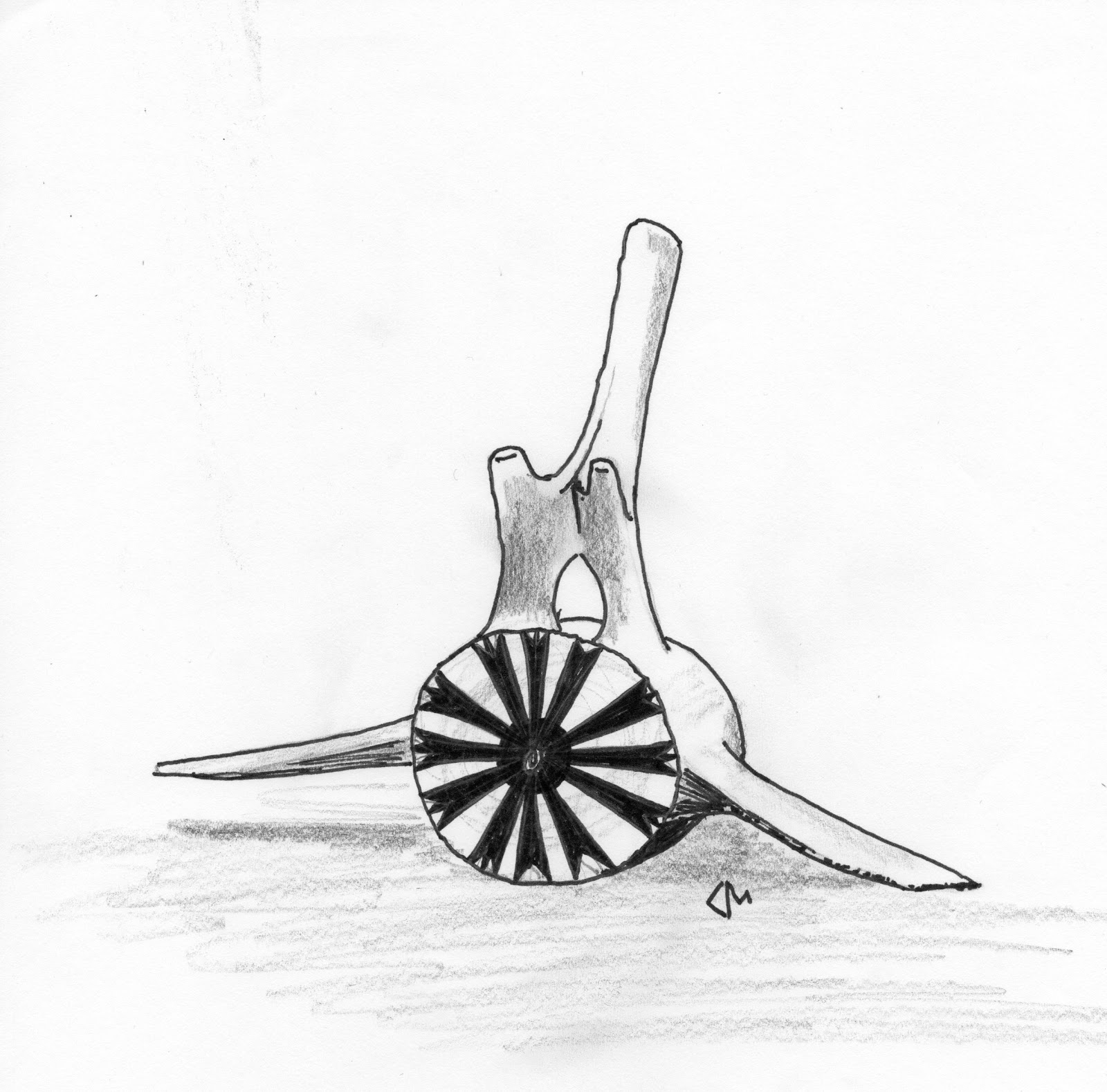
Here, quoting from "Living the Sky" is an account of the Hutash ceremony, "... the group [Alchuklash and 12 assistants] assembled in mid-morning.  To start the ceremony the old men (antap) brought out several mysterious articles, among which was a whale vertabrae painted with an image of the sun.  Each ray of the sun painting represented one of the twelve months of the year.  After the persons attending placed offerings in several baskets that had been put there for the purpose, one of the old men, who had been sitting on the west side of the room facing east, began to sing three songs of gratitude to the sun as they all waited for the sun to rise symbolically.  A young boy then took the painted sun, which had been lying horizontally on the floor, raised it up with a stick, and held it vertically for all to see.  the sun had risen.  Each woman with a babe still suckling brought him in and held him up to the sun paintings.  Then the leader warned them all to respect Sun and lectured them to follow the proper path and to avoid the dangers to life and property that exist at this time of year.  'None of us in the assembly control our destiny, for we live in the shadow of the sun.'"

Following this ceremony, the Alchuklash priest took on his role as Sun Priest and his assistants became the rays of the sun.  They prepared the people for the coming winter solstice and prepared for the ceremony that would entice the sun to stop moving south and start its movement northward again.

Link to Part 1

-- Courtney Miller

Thursday, February 21, 2013

2 - How the Chumash turned the wayward sun around


Part 2: The Alchuklash

The ancient Chumash Indians of Southern California (see Part 1), relied on their astronomer/priests to guide them in their daily lives and to protect the harmony of their world.  Each village had an astronomer/priest called the “Alchuklash” who possessed the ability to read the sky and make predictions; exert influence over the forces of nature through their connections with the heavens; resolve or preserve the peace among the villages; heal the sick; control the weather; and on and on.  For instance, at birth the Alchuklash would be on hand to name the child based upon the stars.  He had the power to bring rain or turn away storms.  The Alchuklash did this through his knowledge of the stars, sun, and moon similar to the way astrology is used to tell our fortune today.  Their ability and responsibilities gave them great power in their communities.

As Ray A. Williamson put it in his book “Living the Sky”, “The Alchuklash conducted their lives and made their observations of the skies under the basic assumption that the world of humans and everything else in the world were inextricably bound together.  The appropriate human actions could influence the workings of the rest of the cosmos, and vice versa.”

The greatest force in the sky was the sun.  The Chumash name for the sun meant “radiance of a child born on the winter solstice”.  From “Living the Sky, “The sun lived in the Upper World with his two daughters in a house made of quartz crystal.  His wives were the morning and evening stars.  In his daily travels across the sky, he not only carred the sun torch to light the world but also preyed on humans below.  His only clothing was a feather band around his head, into which he would stuff an occasional Chumash child as he traveled.  …  After reaching his house again at sunset, Sun would dine on the humans he chanced to gather up during the day.

“… Sun was a powerful being who brought life in the form of heat and light but could also bring death – presumably to those who deserved it, for he served as a moral symbol as well. ‘Never do anything that is prejudicial or unlawful and think that no one will see you,’ said the Chumash, ‘For while the sun is shining, an eye is here … .’”

The winter solstice was a time of great foreboding for the Chumash as it was for most ancient cultures.  The autumn equinox was a day of perfect balance – the day and the night were of equal length.  But each day after that, night became more dominant and days grew shorter.  Each day the sun traveled further and further south and left in its wake colder and more dreary weather.  Every year the Chumash relied on the Alchuklash to do something to stop the sun from leaving them for good.  They depended upon their astronomer/priests to stop the sun, turn him around and encourage him to start his travels northward again.

In the next segment of “How the Chumash turned the wayward sun around”, we will look at how the Alchuklash prepared for the winter solstice so that they could influence to the sun to turn around.


Thursday, February 14, 2013

1 - How the Chumash turned the wayward sun around


Part 1: The Chumash People of Southern California

From the abundance of the heart, the mouth speaks.  – Chumash saying
 
For thousands of years the Chumash Indians lived in southern California between present day Malibu and Paso Robles.  At times, the population of the Chumash reached over 15,000 with over 150 independent villages.  Technically, they would be classified as “hunter-gatherer”, but because game and plant-life was plentiful and they had the Pacific Ocean in their back yard, they were sedentary – that is, they didn’t have to move around to find food.
Chumash rock art
at Painted Cave

The Chumash were noted for their fine, highly decorated baskets, wooden plates and bowls, their masterfully constructed wood plank boats, small tools, articles of adornment, ropes, twine, nets,  and their especially well-developed rock paintings.  They painted their rock art almost exclusively on the interior walls of caves or rock shelters so they are well-preserved relatively speaking.  But, perhaps what makes their rock art so impressive is the degree of color and detail.  The site we call “Painted Cave” today contains some excellent examples and when I first saw them, I thought I was looking at a beautiful quilt. 
Chumash rock art
at Painted Cave

The Chumash traded extensively with their neighbors and often used decorative shells almost like we use money today.  As with many of the established, sedentary cultures of the time, the Chumash had a well-developed government and religion.  Like the Cherokee of the east, they were a matriarchal society so that lineage was determined by the mother’s family and chiefs were as likely to be women as men.
Painted Cave from above

Since they were not farmers, they had no need for calendars to tell them when to plant or when to harvest, however, they did develop an elaborate calendar based upon the sun, moon and stars.  As Ray A. Williamson states in his book “Living the Sky”, “… it functioned to support the Chumash desire to understand, predict, manipulate, and control the forces that determined their ‘supernatural’ environment.”

Unfortunately, the mechanics of their calendar is not well-understood today.  The Franciscan priests tried to suppress the “pagan” beliefs and rituals of the Chumash and early researchers often failed to ask the right questions.  But dedicated anthropologists like Travis Hudson and his colleagues and J. P. Harrington of the Bureau of American Ethnology have since managed to piece together a rudimentary concept of their astronomy.

Again quoting from “Living the Sky”, “According to Chumash stories, each night celestial teams led by Sun and by Sky Coyote played a gambling game called peon.  On the night before winter solstice, the winners of each game for the year were tallied to see which team won most often.  Moon keeps score.  Moon’s count is the number of days before or after new moon to the winter solstice.  The consequences of Sky Coyote’s victory would be a rainy year and an abundance of food for humans.  If Sun and his team won the yearly tally, food would be scarce and human lives would be lost.”

Peon is still a popular game among tribes in Southern California.  In the game, there are two teams of two or more players.  Each player hides a short, white bone in one hand and a short, black bone in the other and then the player brings around his hands and crosses his arms.  The opposing team elects a “killer” who tries to determine which hand holds the white bone.  The killer nods right or left to signify which hand he has chosen.  If he is correct, the umpire gives him a “counter” stick.  The teams take turns until one team wins all of the counter sticks (usually around 15).


Next segment will explain how the Chumash astronomer/priests were able to change their fate.


-- Courtney Miller