Showing posts with label Chumash Indians. Show all posts

Thursday, February 28, 2013

3 - How the Chumash turned the wayward sun around

Santa Ynez Chumash man
circa 1878
Part 3: Preparing for the Winter Solstice
 
For the ancient Chumash tribe of Southern California (refer to part 1 and part 2), the progressive movement south of the sun was a bad omen.  It meant shorter days and colder weather.  It meant that the whole community had to band together under the leadership of the Alchuklash, their powerful, omniscient astronomer/priests, to encourage the sun to turn around before there were no more days, only night.

They believed that all things are interconnected and that any action in the heavens affected the earth and humans and actions by humans affected the forces around them.   I am reminded of the “butterfly effect” from chaos theory that stated that if a butterfly flaps his wings in South America, it can affect the weather in Texas -- the idea that small things can influence seemingly unrelated things because of the close connection of all things.  The Chumash and many other cultures then and now believe that if you understand these interactions you can manipulate them to your benefit or, conversely, unwittingly bring about great catastrophes by not heeding or understanding the effects of your actions.

Queen Butterfly of South America

In the fall, the month the Chumash called “Hutash”, the Alchuklash began their preparations for the winter solstice.  They tracked the sun’s progress and kept count of the days so they knew how many days after the autumn equinox they had until the winter solstice.  They would come before the people and announce their prediction and order the preparation of the necessary ritual items needed.  Year after year, their rituals had worked and influenced the sun to come back to them and they dared not alter their actions or, perhaps, the sun wouldn’t turn around.  It was certainly too important to leave to chance.


“Hutash” is a complex word with many meanings but all relate to the “place where you are”.  Hutash is the name of “Mother Earth” who planted the seeds that man sprouted from.  It refers to the “axis of the earth” or the sphere where man resides.   Hutash is the name of the evening star which ushers in the month of Hutash.  It was also refered to as the mirror of the sun and the sun as the mirror of Hutash.

As part of the preparations for the winter solstice in the month of Hutash, the Alchuklash and his 12 helpers brought out a small 18” stick with a round, painted rock affixed to one end.  These “sunsticks” represented the axis of the earth, Hutash, and were an important part of the solstice ceremony.  The rock was tilted at an angle so the the sun would shine directly on the top of the rock.
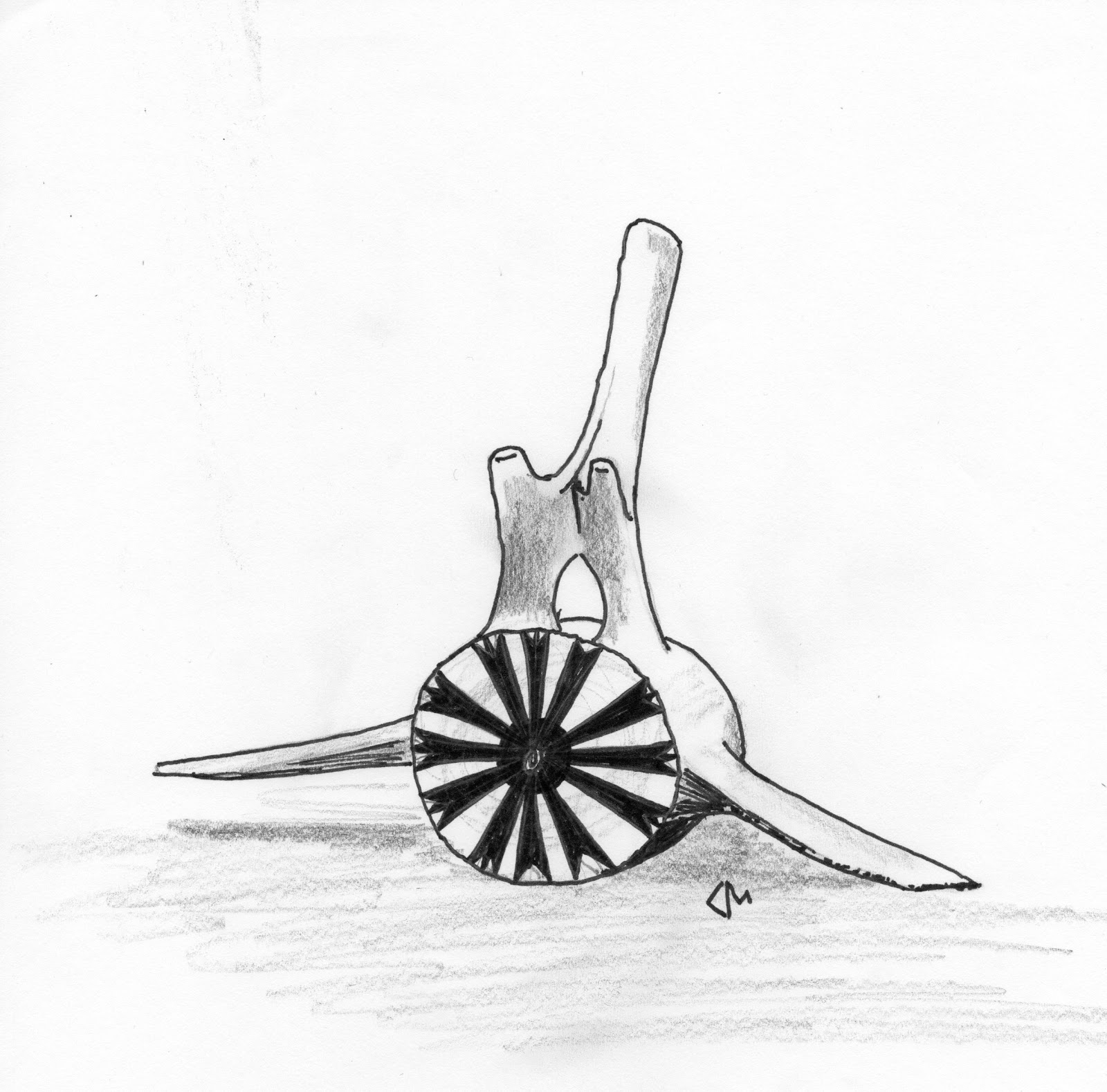
Here, quoting from "Living the Sky" is an account of the Hutash ceremony, "... the group [Alchuklash and 12 assistants] assembled in mid-morning.  To start the ceremony the old men (antap) brought out several mysterious articles, among which was a whale vertabrae painted with an image of the sun.  Each ray of the sun painting represented one of the twelve months of the year.  After the persons attending placed offerings in several baskets that had been put there for the purpose, one of the old men, who had been sitting on the west side of the room facing east, began to sing three songs of gratitude to the sun as they all waited for the sun to rise symbolically.  A young boy then took the painted sun, which had been lying horizontally on the floor, raised it up with a stick, and held it vertically for all to see.  the sun had risen.  Each woman with a babe still suckling brought him in and held him up to the sun paintings.  Then the leader warned them all to respect Sun and lectured them to follow the proper path and to avoid the dangers to life and property that exist at this time of year.  'None of us in the assembly control our destiny, for we live in the shadow of the sun.'"

Following this ceremony, the Alchuklash priest took on his role as Sun Priest and his assistants became the rays of the sun.  They prepared the people for the coming winter solstice and prepared for the ceremony that would entice the sun to stop moving south and start its movement northward again.

Link to Part 1

-- Courtney Miller

Thursday, February 14, 2013

1 - How the Chumash turned the wayward sun around


Part 1: The Chumash People of Southern California

From the abundance of the heart, the mouth speaks.  – Chumash saying
 
For thousands of years the Chumash Indians lived in southern California between present day Malibu and Paso Robles.  At times, the population of the Chumash reached over 15,000 with over 150 independent villages.  Technically, they would be classified as “hunter-gatherer”, but because game and plant-life was plentiful and they had the Pacific Ocean in their back yard, they were sedentary – that is, they didn’t have to move around to find food.
Chumash rock art
at Painted Cave

The Chumash were noted for their fine, highly decorated baskets, wooden plates and bowls, their masterfully constructed wood plank boats, small tools, articles of adornment, ropes, twine, nets,  and their especially well-developed rock paintings.  They painted their rock art almost exclusively on the interior walls of caves or rock shelters so they are well-preserved relatively speaking.  But, perhaps what makes their rock art so impressive is the degree of color and detail.  The site we call “Painted Cave” today contains some excellent examples and when I first saw them, I thought I was looking at a beautiful quilt. 
Chumash rock art
at Painted Cave

The Chumash traded extensively with their neighbors and often used decorative shells almost like we use money today.  As with many of the established, sedentary cultures of the time, the Chumash had a well-developed government and religion.  Like the Cherokee of the east, they were a matriarchal society so that lineage was determined by the mother’s family and chiefs were as likely to be women as men.
Painted Cave from above

Since they were not farmers, they had no need for calendars to tell them when to plant or when to harvest, however, they did develop an elaborate calendar based upon the sun, moon and stars.  As Ray A. Williamson states in his book “Living the Sky”, “… it functioned to support the Chumash desire to understand, predict, manipulate, and control the forces that determined their ‘supernatural’ environment.”

Unfortunately, the mechanics of their calendar is not well-understood today.  The Franciscan priests tried to suppress the “pagan” beliefs and rituals of the Chumash and early researchers often failed to ask the right questions.  But dedicated anthropologists like Travis Hudson and his colleagues and J. P. Harrington of the Bureau of American Ethnology have since managed to piece together a rudimentary concept of their astronomy.

Again quoting from “Living the Sky”, “According to Chumash stories, each night celestial teams led by Sun and by Sky Coyote played a gambling game called peon.  On the night before winter solstice, the winners of each game for the year were tallied to see which team won most often.  Moon keeps score.  Moon’s count is the number of days before or after new moon to the winter solstice.  The consequences of Sky Coyote’s victory would be a rainy year and an abundance of food for humans.  If Sun and his team won the yearly tally, food would be scarce and human lives would be lost.”

Peon is still a popular game among tribes in Southern California.  In the game, there are two teams of two or more players.  Each player hides a short, white bone in one hand and a short, black bone in the other and then the player brings around his hands and crosses his arms.  The opposing team elects a “killer” who tries to determine which hand holds the white bone.  The killer nods right or left to signify which hand he has chosen.  If he is correct, the umpire gives him a “counter” stick.  The teams take turns until one team wins all of the counter sticks (usually around 15).


Next segment will explain how the Chumash astronomer/priests were able to change their fate.


-- Courtney Miller