Sunday, May 13, 2012

Mound Builders

The Mound Builders

The southeast of the country is dotted with hundreds of mounds and theories abound on what they are and who built them.  Following is an explanation given to James Mooney by the Cherokee Medicine Man, Swimmer, 1887-1890:

Cherokee Mounds
Some say that the mounds were built by another people. Others say they were built by the ancestors of the old Ani Kitu’hwagi for townhouse foundations. The townhouse was always built on the level bottom lands by the river in order that the people might have smooth ground for their dances and ballplays and might be able to go down to water during the dance.
When they were ready to build the mound they began by laying a circle of stones on the surface of the ground. Next they made a fire in the center of the circle and put near it the body of some prominent chie or priest who had lately died - some say seven chief men from the different clans - together with an Ulunsu’ti stone, an uktena scale or horn, a feather from the right wing of an eagle or great Tla nu wa which lived in those days, and heads of seven colors, red, white, black, blue, purple, yellow, and gray-blue. The priest then conjured all these with disease, so that, if ever an enemy invaded the country, even though he should burn and destroy the town and the townhouse, he would never live to return home.

Sacred Fire
The mound was then built up with earth, which the women brought in baskets, and as they piled it above the stones, the bodies of their great men, and the sacred things, they left an open place at the fire in the center and let down a hollow cedar trunk, with the bark on, which fitted around the fire and protected it from the earth. This cedar log was cut long enough to reach nearly to the surface inside the townhouse when everything was done. The earth was piled up around it, and the whole mound was finished off smoothly, and then the townhouse was built upon it. One man, called the Firekeeper, stayed always in the townhouse to feed and tend the fire. When there was to be a dance or a council, he pushed long stalks of atsil sun ti (fleabane), "the fire maker" down through the opening in the cedar log to the fire at the bottom. He left the ends of the stalks sticking out and piled lichens and punk around, after which he prayed, and as he prayed, the fire climbed up along the talks until it caught the punk. Then he put on wood, and by the time the dancers were ready there was a large fire blazing in the townhouse. After the dance he covered the hole over again with ashes, but the fire was always smoldering below. Just before the Green corn dance, in the old times, every fire in the settlement was extinguished and all the people came and got new fire from the townhouse. This was called atsi’la galunkw it’yu "the honored or sacred fire." Sometimes when the fire in a house went out, the woman came to the Firekeeper, who made a new fire by rubbing an ihya’ga stalk against the under side of a hard dry fungus that grows along locust trees.
Some sat this everlasting fire was only in the larger mounds at Nikwasi, Kitu’hwa, and a few other towns, and that when the new fire was thus drawn up for the Green Corn dance it was distributed from them to the other settlements. The fire burns yet at the bottom of these great mounds, and when the Cherokee soldiers were camped near Kitu’hwa during the Civil War, they saw smoke still raising from the mound.

Sacred Things
The Cherokee once had a wooden box, nearly square and wrapped up in buckskin, in which they kept the most sacred things of their old religion. Upon every important expedition, two priests carried it in turn and watched over it in camp so that nothing could come near to disturb it. The Delawares captured it more than a hundred years ago, and after that the old religion was neglected and trouble came to the Nation. They had also a great peace pipe, carved from white stone, with seven stem-holes, so that seven men could sit around and smoke from it at once at their peace councils. In the old town of Keowee they had a drum of stone, cut in the shape of a turtle, which was hung up upside the townhouse and used at all the town dances. The other towns of the Lower Cherokee used to borrow it too, for their own dances.

All the old things are gone now and the Indians are different.

Sunday, May 6, 2012

Becoming a Cherokee Medicine Man

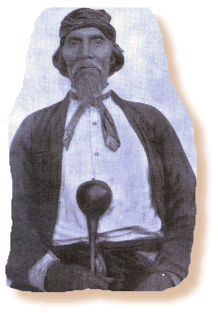
Swimmer,
a Cherokee Medicine Man
circa 1880
Think you might want to be a Cherokee medicine man?  Are you ready to commit 15 to 20 years studying the 7 disciplines required?  Cherokee medicine, nvwoti (noo wat ee),  is a practice that has developed over the last 3,000 to 4,000 years  and can’t be mastered overnight!  A Cherokee medicine man, Didanawisgi, typically started studying very young as an apprentice with the dream of one day becoming the high master or  Uku!

Following is a list of the seven disciplines as described by Cherokee Medicine and Ethnobotany - ©David Winston, AHG, 2001:

1. Herbal Medicine - an in-depth knowledge of 400-600 plants, their medicinal and ceremonial uses as well as the plants "personality".
2. Physical Medicine - including the unique Cherokee massage (hiskoliya) using persimmon wood stampers, moxabustion, minor surgery, & midwifery.
3. Dreamwork - not only how to interpret dreams, but how to use them for personal growth, healing, and to gain knowledge.
4. Language/Myths/Laws - Cherokee is a language of amazing subtlety and power. The tsila learns not only the subtleties of every day spoken Cherokee, but a separate "medicine" language. Stories, myths, and laws give meaning to the world and help us to understand our place in the Great Life.
5. Ceremonies - the Cherokee traditionally had 7 major ceremonies, 6 of which marked the important yearly cycles, such as the first new moon of Spring, green corn harvest, mature corn harvest, falling leaves festival, and the beginning of winter/exulting ceremony. Many of these ceremonies are still done today and are as meaningful now, if not more so, than in times past. Ceremonial practice also
includes various types of personal, family, community, and national ceremonies that help maintain balance within the individual, the family, the community, and the nation.
6. The laws of nature - keen observers, the Cherokee have for thousands of years paid attention to the world around them. This collected body of knowledge is extensive and it explains why things act as they do and the cause and effect of their interrelationship - why animals behave certain ways, how the sun and moon interrelate, how men and women interact, the nature of water, the fire, the
earth (ela), and so on.
7. Conjuring - although there is no really good word in English to describe this, various words - conjuring, magic, manipulation, partially explain this practice. This is the ability to enlist the aid of spirits and elemental powers to change things, to heal or doctor, to "change one's mind", to bring luck and to protect the sick or weak from negative influences.

The Cherokee credit two sources for much of their knowledge of medicine .First from the plants (refer to  my  April blog, “A Better Healthcare Plan”).  The second from the ancient cannibalistic monster/wizard known as Stone-clad (nvyunuwi).  He was almost impossible to kill because of his incredible wisdom and because he wore  complete body armor made of stone.  But he met his end when he approached a village and the villagers went to their most knowledgeable wizard and asked for his help.  He summoned seven women, from the seven clans who were in their period, and placed them in the path of the advancing Stone-Clad.  James Mooney, in his "Myths of the Cherokee" describes what happened next,

"with each one that he saw his step grew weaker until
when he came to the last one, with whom the sickness had just begun,
the blood poured from his mouth and he fell down on the trail.

Then the medicine-man drove seven sourwood stakes through his
body and pinned him to the ground, and when night came they piled
great logs over him and set fire to them, and all the people gathered
around to see. Nuii'yunu'wi (Stone-Clad) was a great ada'wehi and knew many
secrets, and now as the fire came close to him he began to talk, and
told them the medicine for all kinds of sickness. At midnight he
began to sing, and sang the hunting songs for calling up the bear and
the deer and all the animals of the woods and mountains. As the
blaze grew hotter his voice sank low and lower, until at last when
daylight came, the logs were a heap of white ashes and the voice
was still."

So, the conjures and songs of Stone-clad and the medicinal plants formed the foundation for the last and first disciplines.  The rest were developed over time and taught orally to each generation.  Ready to enroll?

Sunday, April 29, 2012

Eat Your Heart Out, Harry Potter!

It seems that all cultures have practitioners of the dark arts!  Witches have played a big part in American history.  The most famous were perhaps the Salem Witches.  Witches and wizards also played an important role in Native American culture.  Following is an excerpt from the Nineteenth Annual Report of the Bureau of American Ethnology 1897-98, Part I. [1900] written by James Mooney.

“Of all the Cherokee wizards or witches the most dreaded is the Raven Mocker (Kâ'lanû Ahkyeli'skï), the one that robs the dying man of life. They are of either sex and there is no sure way to know one, though they usually look withered and old, because they have added so many lives to their own.
At night, when some one is sick or dying in the settlement, the Raven Mocker goes to the place to take the life. He flies through the air in fiery shape, with arms outstretched like wings, and sparks trailing behind, and a rushing sound like the noise of a strong wind. Every little while as he flies he makes a cry like the cry of a raven when it "dives" in the air--not like the common raven cry--and those who hear are afraid, because they know that some man's life will soon go out. When the Raven Mocker comes to the house he finds others of his kind waiting there, and unless there is a doctor on guard who knows bow to drive them away they go inside, all invisible, and frighten and torment the sick man until they kill him. Sometimes to do this they even lift him from the bed and throw him on the floor, but his friends who are with him think he is only struggling for breath.
After the witches kill him they take out his heart and eat it, and so add to their own lives as many days or years as they have taken from his. No one in the room can see them, and there is no sear where they take out the heart, but yet there is no heart left in the body. Only one who has the right medicine can recognize a Raven Mocker, and if such a man stays in the room with the sick person these witches are afraid to come in, and retreat as soon as they see him, because when one of them is recognized in his right shape he must die within seven days.
… The other witches are jealous of the Raven Mockers and afraid to come into the same house with one. Once a man who had the witch medicine was watching by a sick man and saw these other witches outside trying to get in. All at once they heard a Raven Mocker cry overhead and the others scattered "like a flock of pigeons when the hawk swoops." When at last a Raven Mocker dies these other witches sometimes take revenge by digging up the body and abusing it.”
From "Analiheliga", my novel on the Cherokee, as yet unpublished.
The Raven Mocker is flying across the Moon in the background.

Other reports say that the Raven Mocker had to capture the four souls, askinas, of the victim to acquire his life.  The first of the four souls is the soul of conscious life which animates the other three souls. Because it resides just below the scalp, originally scalping was done to capture this soul of the victim.  When a person dies, the first soul immediately leaves the body and continues its personal life, sometimes remaining nearby for awhile and sometimes seen as a ghost.  The Raven Mocker was believed to capture this soul by sucking out the last breath of his victim.

The second soul is the soul of physiological life and resides in the liver.  The Raven Mocker acquired this soul by eating the victim’s liver.  Thirdly, the soul of circulation resided in the bloodstream and was acquired by the Raven Mocker by eating the victim’s heart.  The last soul, the soul of energy is located in the bones.  The Raven Mocker acquired this soul by eating the victim’s bone marrow.  But, perhaps, the most important part of the Raven Mocker’s ritual was the conjure.  Without the appropriate words, the transfer of the victim’s life would not complete.

Eat your heart out, Harry Potter -- pardon the pun.

Sunday, April 22, 2012

Who was Kokopelli, really?

We know Kokopelli today as a crooked little flute player that is the subject of southwestern jewelry. Many know that the symbol is taken from petroglyphs found etched in the patina of countless canyon walls and boulders throughout the southwest. Because of the age of the glyphs, they were most likely chiseled out by the Anasazi and Hohokam cultures. The Kokopelli myths are wonderfully rich and intriguing, but who he really was is probably impossible to ever know.

Still revered by current descendants of Native Americans (including the Hopi, Taos, and Acoma Pueblo peoples), he is truly one of the most renowned and widespread images to have survived from ancient Indian mythology. First depicted by the Anasazi, Kokopelli was a fertility symbol bringing good crops of corn, beans, and squash. His visit also brought rain for the fields, streams and reservoirs. The Zuni claimed he could make it rain at will.

Kokopelli’s image varied over time. Originally drawn as a bug-like creature with large tentacles on his head, a great, humped back, playing a long flute,and exhibiting male genitalia of exaggerated size. Over time, the image became more stylized with an arched back, wearing a long dress or tunic. The disappearance of the phallus is speculated to be due to contact with Europeans. But in ancient myths, he brought fertility in all ways to the village. Women, who previously were unable to bear children would become pregnant after a visit from Kokopelli!

So who was this curious little man really? Because of his widespread appearance -- from Mexico to west of the Mississippi -- I think Kokopelli represented the travelling merchant or trader. He most likely dealt with (or was one of the) Pochteca that were traveling merchants in the Aztec Empire. His humped back originally looked a lot like a tump basket. These large “baskets” were actually more like large slings, slung over the forehead that hung down the back enabling one to carry huge amounts of corn, beans, or squash. I suspect that he became associated with good harvests and rain because he would have selected villages that had good harvests to trade with. The traders/merchants were very important to villages of America. It must have been exciting to see the unusual beads, conch shells, Quetzal feathers, and other treasures from other cultures.

Sunday, April 15, 2012

Martin/Zimmerman 1000 Years Ago

What if 1,000 years ago, in a remote Cherokee village, a village sentinel had discovered a stranger passing through his village and after a confrontation, the visitor was killed?  How would justice have been administered? 

For the ancient Cherokee, justice meant restoring harmony and balance.  Ahnawake Carroll, a Juris Doctorate candidate at the University of New Mexico School of Law, puts it this way, “... Cherokees lived by ‘a clearly established pattern and structure to their lives, sustained by age-old customs, rituals, beliefs, ceremonies, and symbols guiding the rightful and eternal order of things.  These prescriptions for conduct embodied “spiritual significance in every respect’ and ‘there was no secular area of life free from spiritual meaning’ because all aspects of Cherokee life were ‘woven together into a unified pattern of religious rules and connections involving harmony with the world above, the world below, and the world around….”

The Cherokee would have had several options for determining restitution.  If the visitor were seen as an intruder, restitution could have been determined by the “Ghigua”, or “Beloved Women”.  The Beloved Women  were chosen by each clan based on their bravery in battle or outstanding qualities, and it was the highest honor they could achieve. The Ghigua headed the Council of Women and sat on the Council of Chiefs. The Ghigua decided the fate of prisoners and might also be called upon to be her people's sage and spiritual guide.

Again from Ahnawake Carroll, “Cherokee law was not a law of individual responsibility but of clan relationships: a law which consisted largely of procedural rules defining who could act, when he could act, and what form his action should take.”

William G. McLoughlin,  in “Cherokee Renascence in the New Republic 10-11 (1986), states, “as an extended family the clan had the duty to avenge or seek restitution for loss by death (whether by malice or accident) of any of its members. Under traditional Cherokee homicide law, basically, when one Cherokee killed another Cherokee, their respective clans would settle the matter internally through restitution.  There was an exception to this stringent rule, however, that involved the ability of an ‘individual who had innocently or by accident taken the life of another…[to] flee to one of four ‘free cities,’ or ‘sacred cities of refuge,’ where the murderer would be safe.  A priest might offer the same protection on sacred ground in any town.’  It must be kept in mind, however, “[t]he purpose of clan retaliation was not punitive but rather to equalize the balance of things and to overcome the disorder brought by premature death.”

Sculptor Troy Jackson 

If there were a question regarding the story of the killer, the “Ukus”, high priests, could be called in to determine the truth.  Typically, the Ukus would consult their beads.  They would hold a white bead in the tips of the fingers of their right hand and a red or black bead in the tips of the fingers of their left hand.  Holding the beads up and grasping them as gently as possible, they would begin a chant designed to consult with the spirits who could see all things and tell them the truth.  If the Uku felt movement in the white bead, then the killer had told the truth.  If, however, he felt movement in the other bead, the killer was lying.

If restitution called for the death of the killer, often the family of the killer was responsible for carrying it out, typically by binding the hands and feet and pushing him off a high cliff.


Sunday, April 8, 2012

Take Me Back to the Ball Play!

With baseball season about to open, I wonder what we would do without our ball games?  What did Native Americans do?  Well, they had their own ball game and it was every bit as important to them as baseball, football, and soccer are to us today. All across North America, Native Americans enjoyed a ball game that we might identify as LaCrosse today.  That’s because LaCrosse came from that Native American game!

Generally, the “anetsa”, ball play, was the same all across the country with a couple of exceptions.  Northern and western tribes used one ball stick, while the Gulf States preferred to use two and trap the ball between the two nets.  Another exception was that along the west coast, both men and women played together, but most other tribes considered it a manly game and believed that defeat was assured if women even touched a ball stick!

It is said that ball play was invented to replace war.  The Cherokee have a legend that after many years of fighting with the Iroquois, the two chiefs got together in council and decided to replace the fighting with the anetsa.  After that, every year the two tribes faced off in a national game and peace was maintained.  In another legend, the border between the Tsalagi (Cherokee) and the Kusa (Creek) was a point of contention and was settled when the Tsalagi defeated the Kusa in a ball play.  James Mooney tells of another important anetsa, “On the fourth of June, 1763, the birthday of King George of England, the warriors of two great tribes assembled in front of the fort, ostensibly to play a game in honor of the occasion and to decide the tribal championship. The commandant himself came out to encourage his favorites and bet on the result, while the soldiers leaned against the palisades and the {women} sat about in groups, all intently watching every movement of the play. Suddenly there comes a crisis in the game. One athletic young fellow with a powerful stroke sends the ball high in air, and as it descends in a graceful curve it rolls along the ground to the gate of the fort, followed by four hundred yelling {Native Americans}. But look! As they run each painted warrior snatches from his {wife} the hatchet which she had concealed under her blanket, and the next moment it is buried in the brain of the nearest soldier. The English, taken completely by surprise, are cut down without resistance!”

The equipment needed for the game was simple -- one or two netted sticks and a small deer skin ball.  The rules were also simple.  Each team had to have equal number of players.  So, if one team showed up with more players, the extra players sat out the game.  Two poles were placed at each end of the field and a team scored by tossing the ball between the poles.  The first team to score 12 points was the victor.

James Mooney also described some of the restrictions:

“In addition to the athletic training, which begins two or three weeks before the regular game, each player is put under a strict gaktûnta, or tabu, during the same period. He must not eat the flesh of a rabbit (of which the Indians generally are very fond) because the rabbit is a timid animal, easily alarmed and liable to lose its wits when pursued by the hunter. Hence the ball player must abstain from it, lest he too should become disconcerted and lose courage in the game. He must also avoid the meat of the frog (another item on the Indian bill of fare) because the frog's bones are brittle and easily broken, and a player who should partake of the animal would expect to be crippled in the first inning. For a similar reason he abstains from eating the young of any bird or animal, and from touching an infant. He must not eat the fish called the hog-sucker, because it is sluggish in its movements. He must not eat the herb called atûnka or Lamb's Quarter (Chenopodium album), which the Indians use for greens, because its stalk is easily broken. Hot food and salt are also forbidden, as in the medical gaktûnta. The tabu always lasts for seven days preceding the game, but in most cases is enforced for twenty-eight days--i. e., 4 x 7--four and seven being sacred numbers. Above all, he must not touch a woman, and the player who should violate this regulation would expose himself to the summary vengeance of his fellows. This last tabu continues also for seven days after the game. As before stated, if a woman even so much as touches a ball stick on the eve of a game it is thereby rendered unfit for use. As the white man's law is now paramount, extreme measures are seldom resorted to, but in former days the punishment for an infraction of this regulation was severe, and in some tribes the penalty was death. Should a player's wife be with child, he is not allowed to take part in the game under any circumstances, as he is then believed to be heavy and sluggish in his movements, having lost just so much of his strength as has gone to the child. At frequent intervals during the training period the shaman takes the players to water and performs his mystic rites, … They are also "scratched" on their naked bodies, as at the final game, but now the scratching is done in a haphazard fashion with a piece of bamboo brier having stout thorns which leave broad gashes on the backs of the victims.”

In many cases, the players had no other responsibility in the tribe or village -- sort of professionals like today.  There were even special songs and dances for the anetsa not unlike “Take Me Out to the Ball Game!”

Sunday, April 1, 2012

A Better Healthcare Plan?

This week the Supreme Court heard arguments on the Constitutionality of the Obama Healthcare plan challenged by 26 states.  The Healthcare Law is over 2,000 pages!  Today, I want to turn the pages back 2,000 years and talk about another healthcare plan.  A plan based on OUR constitution, not the THE Constitution.  And a plan supported by the state of “wellness”!
Cherokee Healer by Thomas E. Mails

The idea of “wellness” was common to most of the ancient Native Americans.  The Cherokee word for health was “tohi” which was also their word for “peace”.  Wellness was a state of harmony between the mind, the body, and the spirit.  The person responsible for the wellness of their community is often referred to today as the “medicine man” or “shaman”.  But a more accurate description would be physician/priest/counselor. The Cherokee word was “Didanawisgi”.  The Didanawisgi focused on the person as opposed to the modern-day doctor that focuses on the disease.  A modern-day Didanawisgi, Dr. C. L. Rogers, M.D., explains it this way:

“ … Modern medicine seemingly is focused on the chemical elements that can be recreated in a laboratory and fed to the patient. Unfortunately, this approach usually results in many side effects and therefore the need for more pills or treatments. What’s wrong with this picture? Where is the concern for the patient’s balance or harmony? Where is the ceremony? Where is the understanding of the power of our immune system that is controlled by our minds, by what we think? Where is the complete healing?”

For the ancient Cherokee, the emphasis was on maintaining wellness – balance and harmony in one’s life – rather than focusing on curing symptoms.  They just didn’t see it as coming down with a disease or illness.  They often spoke of something “being placed under them”.  When a Didanawisgi would examine someone with an illness, they might ask “have you broken any taboos?”  It was important to follow the “white path” to maintain wellness or balance.  They believed that there was a strong connection to all things natural to achieve or maintain harmony within.  To the Didanawisgi, the ceremony and the conjure were just as important as the medicine for healing.

James Mooney spent 26 years with the Cherokee starting in 1885 and his works remain the most comprehensive and authoritative on Cherokee Lore.  In his book “Myths of the Cherokee”, he features “Origin of Disease and Medicine” which gives us an interesting insight into Cherokee medicine.  Here is an excerpt:

In the old days the beasts, birds, fishes, insects, and plants could all talk, and they and the people lived together in peace and friendship. But as time went on the people increased so rapidly that their settlements spread over the whole earth, and the poor animals found themselves beginning to be cramped for room. This was bad enough, but to make it worse Man invented bows, knives, blowguns, spears, and hooks, and began to slaughter the larger animals, birds, and fishes for their flesh or their skins, while the smaller creatures, such as the frogs and worms, were crushed and trodden upon without thought, out of pure carelessness or contempt. So the animals resolved to consult upon measures for their common safety.

… They began then to devise and name so many new diseases, one after another, that had not their invention at last failed them, no one of the human race would have been able to survive …

… When the Plants, who were friendly to Man, heard what had been done by the animals, they determined to defeat the latter's evil designs. Each Tree, Shrub, and Herb, down even to the Grasses and Mosses, agreed to furnish a cure for some one of the diseases named, and each said: "I shall appear to help Man when he calls upon me in his need." Thus came medicine; and the plants, every one of which has its use if we only knew it, furnish the remedy to counteract the evil wrought by the revengeful animals. Even weeds were made for some good purpose, which we must find out for ourselves. When the doctor does not know what medicine to use for a sick man the spirit of the plant tells him.

If the Supreme Court decides that Obamacare is unconstitutional and throws it out so that congress has to start over, do you think there is any chance they might consider the Cherokee plan?