Showing posts with label medicine man. Show all posts

Thursday, June 6, 2013

Cherokee Witchcraft: How the medicine men dealt with a Raven Mocker

Part 4

The Raven Mocker witch
could shape-shift into a raven
The most feared Cherokee witch, the one they called “Raven Mocker”,  was not completely invincible.  The skilled medicine man knew the signs of the Raven Mocker and its malicious intents.  He knew that the Raven Mocker preferred the nights and that he preferred preying on the sick and the weak.  So, when a loved one was sick, these special medicine men (or women) were sought out and asked to sit with their loved one through the night.
 
There were numerous methods that were known to enable the detection of the witch.  The Raven Mocker, according to accounts recorded by James Mooney, “… flies through the air in fiery shape, with arms outstretched like wings, and sparks trailing behind … Every little while as he flies he makes a cry like the cry of a raven”.  [refer to the previous article from Native American Antiquity:  Cherokee Witches: Kâ'lanû Ahkyeli'skï]
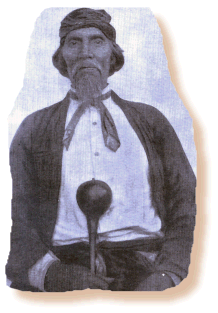
Ayunini (Swimmer)
Famous Cherokee Medicine Man

Another method, quoting from “The Swimmer Manuscript” by James Mooney, revised and edited by Frans Olbrects (Swimmer was a famous Cherokee medicine man that was Mooney’s principle informant on the history, mythology, … medicine and botany of the Cherokee), “This work consists in smoothing a small heap of ashes, about 20-25 centimeters in diameter, aside from the hearth, and occasionally dropping a tiny pinch of finely crushed tso’ lagayo-nli (“old tobacco,” Nicotiana rustica L) on it; the center of the hot ashes are thought of as representing the patient’s cabin; any particle of the tobacco dust catching fire, to the right or to the left of the center, indicates the position from where the witch is approaching.  If the dust alights on the center of the ashes it is a sign that the witch is right overhead, and should the tobacco, as it drops on the center, take fire with a crack or a burst, it shows that the witch has already entered the room.  In this case the burst will cause the death of the witch within four days, if she is one of the kind that has fasted for four days to attain her occult power; within seven days if she is one of the kind that ‘has got the utmost’”

It was also believed that by drinking a special mixture, sometimes called the “witch’s tea”, the
consumer could “see” the witch in his natural form and, thereby, cause the witch’s death.  According to Alan Kilpatrick, in his book “The Night Has a Naked Soul”, “… the four ingredients of this exotic brew (which were crushed and steeped in water) were algae collected from rocks in a mountain stream, phosphorescent wood extracted from a putrified stump, and two species of insect plants (Cordyceps) that contain the hallucinatory properties of ergot and lysergic acid diethylamide.”

Witches, whether a Raven Mocker or just a common witch, were blamed for a person’s sickness.  When interrogating a patient, the medicine man would usually ask if the patient knew “who put the thing [curse] under them” that disrupted their healthy condition.  The medicine man didn’t treat the sickness as we think of it today, they worked to remove that which was interrupting their health by restoring harmony and balance.  So, a treatment would not only include medicine but required the appropriate prayers or conjures to address the complete health of the patient.  A person’s physical health was linked with his mental health and both had to be addressed to be well.  It bothers me that our doctors today have not learned this and rarely address both when treating their patients.  It is too easy to just prescribe a drug and hope it drives out the sickness. 


Thursday, May 16, 2013

Cherokee Witchcraft: Nûñ'yunu'wï

Part 1: Nûñ'yunu'wï


Merlin
Voodoo Devil
Mankind seems to have an inherent fascination with witchcraft.   From Merlin in King Arthur’s court to Voo Doo in the Carribean it is celebrated in some cultures and, as with the Salem Witches, denounced by others.  The Cherokee had their share of witches.  Sometimes the difference between a witch and a medicine man was a very fine line.  But the distinction was important because the medicine man was revered, but the witch was reviled. 


Swimmer, Cherokee Medicine Man
Although James Adair made mention of Cherokee witchcraft in 1775, it wasn’t until 1891 that any serious research was published.   James Mooney’s monumental works, “Myths of the Cherokee”, “Sacred Formulas of the Cherokees”  were the culmination of 36 years of research living among the Cherokee while working for the Bureau of American Ethnology.  These works are still the most comprehensive and authoritative publications on the subject.  His notes were later the subject of the book "The Swimmer Manuscript".


In the 1960’s, the subject was comprehensively studied by two distinguished scholars, Dr. Jack Frederick Kilpatrick and his wife, Mrs. Anna Gritts Kilpatrick, both Cherokee.  They interviewed hundreds of Cherokee and collected texts and notes written in native script (Sequoyah syllabary).  They translated these texts and published numerous books and monographs.  Later, their son, Alan Kilpatrick, studied their work and collection and wrote a very enlightening book, “The Night Has a Naked Soul”,  that looks at traditional Cherokee religious practices from a Cherokee anthropologist’s point of view.

Kokopelli with his magic cane
used sometimes as a flute
other times as a planting stick
In this Native American Antiquity series, I want to pull from these sources and take a look at what the characteristics of a Cherokee witch were.  Let’s start with Nûñ'yunu'wï, which translates as “Stone Clad”.   Quoting from Mooney, “This is what the old men told me when I was boy.

“Once when all the people of the settlement were out in the mountains on a great hunt one man who had gone on ahead climbed to the top of a high ridge and found a large river on the other side. While he was looking across he saw an old man walking about on the opposite ridge, with a cane that seemed to be made of some bright, shining rock. The hunter watched and saw that every little while the old man would point his cane in a certain direction, then draw it back and smell the end of it. At last he pointed it in the direction of the hunting camp on the other side of the mountain, and this time when he drew back the staff he sniffed it several times as if it smelled very good, and then started along the ridge straight for the camp. He moved very slowly, with the help of the cane, until he reached the end of the ridge, when he threw the cane out into the air and it became a bridge of shining rock stretching across the river. After he had crossed over upon the bridge it became a cane again, and the old man picked it up and started over the mountain toward the camp.

Mayan ballplayer
with stone "donut" around his body


“The hunter was frightened, and felt sure that it meant mischief, so he hurried on down the mountain and took the shortest trail back to the camp to get there before the old man. When he got there and told his story the medicine-man said the old man was a wicked cannibal monster called Nûñ'yunu'wï, "Dressed in Stone," who lived in that part of the country, and was always going about the mountains looking for some hunter to kill and eat. It was very hard to escape from him, because his stick guided him like a dog, and it was nearly as hard to kill him, because his whole body was covered with a skin of solid rock. If he came he would kill and eat them all, and there was only one way to save themselves …”

I love this story because I think it is an excellent example of the creative story-telling of the Cherokee.  Next week, we will find out what one thing could stop Nûñ'yunu'wï and then discuss the characteristics this amazing witch may share with other witches and what the implications may be.


Sunday, May 6, 2012

Becoming a Cherokee Medicine Man

Swimmer,
a Cherokee Medicine Man
circa 1880
Think you might want to be a Cherokee medicine man?  Are you ready to commit 15 to 20 years studying the 7 disciplines required?  Cherokee medicine, nvwoti (noo wat ee),  is a practice that has developed over the last 3,000 to 4,000 years  and can’t be mastered overnight!  A Cherokee medicine man, Didanawisgi, typically started studying very young as an apprentice with the dream of one day becoming the high master or  Uku!

Following is a list of the seven disciplines as described by Cherokee Medicine and Ethnobotany - ©David Winston, AHG, 2001:

1. Herbal Medicine - an in-depth knowledge of 400-600 plants, their medicinal and ceremonial uses as well as the plants "personality".
2. Physical Medicine - including the unique Cherokee massage (hiskoliya) using persimmon wood stampers, moxabustion, minor surgery, & midwifery.
3. Dreamwork - not only how to interpret dreams, but how to use them for personal growth, healing, and to gain knowledge.
4. Language/Myths/Laws - Cherokee is a language of amazing subtlety and power. The tsila learns not only the subtleties of every day spoken Cherokee, but a separate "medicine" language. Stories, myths, and laws give meaning to the world and help us to understand our place in the Great Life.
5. Ceremonies - the Cherokee traditionally had 7 major ceremonies, 6 of which marked the important yearly cycles, such as the first new moon of Spring, green corn harvest, mature corn harvest, falling leaves festival, and the beginning of winter/exulting ceremony. Many of these ceremonies are still done today and are as meaningful now, if not more so, than in times past. Ceremonial practice also
includes various types of personal, family, community, and national ceremonies that help maintain balance within the individual, the family, the community, and the nation.
6. The laws of nature - keen observers, the Cherokee have for thousands of years paid attention to the world around them. This collected body of knowledge is extensive and it explains why things act as they do and the cause and effect of their interrelationship - why animals behave certain ways, how the sun and moon interrelate, how men and women interact, the nature of water, the fire, the
earth (ela), and so on.
7. Conjuring - although there is no really good word in English to describe this, various words - conjuring, magic, manipulation, partially explain this practice. This is the ability to enlist the aid of spirits and elemental powers to change things, to heal or doctor, to "change one's mind", to bring luck and to protect the sick or weak from negative influences.

The Cherokee credit two sources for much of their knowledge of medicine .First from the plants (refer to  my  April blog, “A Better Healthcare Plan”).  The second from the ancient cannibalistic monster/wizard known as Stone-clad (nvyunuwi).  He was almost impossible to kill because of his incredible wisdom and because he wore  complete body armor made of stone.  But he met his end when he approached a village and the villagers went to their most knowledgeable wizard and asked for his help.  He summoned seven women, from the seven clans who were in their period, and placed them in the path of the advancing Stone-Clad.  James Mooney, in his "Myths of the Cherokee" describes what happened next,

"with each one that he saw his step grew weaker until
when he came to the last one, with whom the sickness had just begun,
the blood poured from his mouth and he fell down on the trail.

Then the medicine-man drove seven sourwood stakes through his
body and pinned him to the ground, and when night came they piled
great logs over him and set fire to them, and all the people gathered
around to see. Nuii'yunu'wi (Stone-Clad) was a great ada'wehi and knew many
secrets, and now as the fire came close to him he began to talk, and
told them the medicine for all kinds of sickness. At midnight he
began to sing, and sang the hunting songs for calling up the bear and
the deer and all the animals of the woods and mountains. As the
blaze grew hotter his voice sank low and lower, until at last when
daylight came, the logs were a heap of white ashes and the voice
was still."

So, the conjures and songs of Stone-clad and the medicinal plants formed the foundation for the last and first disciplines.  The rest were developed over time and taught orally to each generation.  Ready to enroll?