I don’t remember where I first heard it, but growing up it seemed to be just common knowledge that American Indian “Squaws” followed their husbands a respectful ten paces behind. Today, I doubt that this was a practice by any Native American culture. But, there is no question, that in the Cherokee culture, women were not subservient to men.

The Cherokee were a matriarchal society. The woman was the head of the household and the children were born into her clan. My father’s last name is Miller and my mother’s maiden name is McDaniel. So, my last name is Miller. But, had we been living in a Cherokee system when I was born, my last name would be McDaniel and I would’ve been taught the ways of the McDaniel clan by my mother’s uncles.
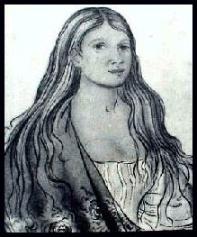
The Cherokee had seven clans and each clan usually had a woman, called Ghigau, or Blessed Woman. The Ghigau were women who had earned the respect of their clan and represented their clan in Council meetings and were in on decisions. The Beloved women were also responsible for deciding the fate of prisoners.
 |
| Nanyehi, Cherokee Ghigau |
Women could be chiefs, Uku’s, priests, virtually any position men could have and women often fought in wars beside the men. About 1751, a young girl named Nanyehi married the Cherokee "Tsu-la". In the Battle of Taliwa against the Creeks , Nanyehi lay behind a log in order to chew his bullets so that the resulting jagged edges might create more damage. When Tsu-la was killed, Nanyehi picked up his rifle and continued the fight leading her people to victory.
In 1776, after the Cherokee attacked Fort Watauga, Nanyehi used her power as a Ghigau to spare the life of captured Lydia Russell Bean. Mrs. Bean taught Nanyehi a new loom weaving technique that revolutionized Cherokee garments and dairy farming.

[Burial tribute to Nanyehi]
[To learn more about Nanyehi, read “When Women Ruled” from the archives of Native American Antiquity]
“The European culture viewed the role of women in Cherokee government with disdain. In the early 1700’s, the trader Adair coined the phrase ‘petticoat government’ to describe the prominence of the women’s role.”
 In an article published January, 2011 in the online e-zine “Indian Country” the following was quoted from Wilma Dunaway, professor of sociology at Virginia Polytechnic Institute and State University and author of “Rethinking Cherokee Acculturation; Agrarian Capitalism and Women’s Resistance to Cult of Domesticity, 1800-1838:
“By the 1800s the Cherokees had lost their independence and had become dominated by white Americans,” said Johnston. “At this time white Americans did not believe that it was proper for women to fight wars, vote, speak in public, work outside the home or even control their own children. The Cherokees began to imitate whites, and Cherokee women lost much of their power and prestige. In the 20th century, they had to struggle along with other women to acquire many of the rights that Cherokee women once freely enjoyed.”
I am pretty sure that had a Cherokee husband commanded his “squaw” to walk ten paces behind him prior to the arrival of Europeans, he would have found his stuff piled up outside the front door of the house. That was how a Cherokee woman divorced her husband.
Author of the Cherokee Chronicles
Book One: The First Raven Mocker

Look for The First Raven Mocker at a book store near you
or at Barnes and Noble or Amazon.com