Thursday, November 29, 2012

Native American Skies - Pawnee Morningstar Ritual, Part 1


Pawnee Lodge
It was the spring of 1838 when a 14-year-old Oglala Sioux girl named Haxti lead a procession of Skidi Pawnee toward the approaching sunrise.  She was painted and dressed for a sacred Pawnee “Morning Star” ritual.   She most likely had no idea what was about to happen but did not resist since she had been living with the Pawnee since the previous autumn and had been fed and treated very well.   The procession that followed her was made up of all the men, boys and male infants from the village. 

She was directed to stand before a wooden scaffold by the Pawnee High Priest.  The scaffold was constructed of sacred woods and  leathers from different animals each representing one of the directions – elm for north, cottonwood for south, etc.   It was built outside the village and erected over a pit with elements relating to the four cardinal directions and lined with downy feathers and represented the Evening Star’s garden of germination in the west.   While they waited, the priests and procession sang four songs.  They sang of the girl, about Heaven, and about the powers of the beasts of the four parts of earth.
Haxti sacrifice to Morning Star 1838

When the star was due to rise, the girl was directed to stand on the fourth post and then was tied to the top post on the scaffold.   At the moment the star appeared above the horizon,  two priests rushed up and branded her under her arm pits and near her groin as the man who had captured her and dedicated her to the Morning Star fired an arrow into her heart.  The High Priest then cut her above her heart with a flint knife and smeared his face with her blood.  Some of her blood was allowed to drip onto the dried heart and tongue of a buffalo and more to flow into the feathery pit below.  When the High Priest stepped away, all those in the procession fired their arrows into her  chest to hasten her death.   Haxti’s body was removed from the scaffold and placed face down so that her blood would soak the earth.  Her death insured the renewal of earth and her soul became that of the Morning Star.

 It is believed that she was the last sacrificed in this way after the outcry by settlers in the area.  Sacrificing a maiden in this way shocked the settlers as it shocks us today.  We cannot make sense of the killing of an innocent girl in this way through the filter of our European belief systems.  But, next week I will present the complicated belief system that justified the Morning Star ritual for the Pawnee.
 

Thursday, November 22, 2012

Archaeoastronomy: Medicine Wheels of the Plains Indians


Bighorn Medicine Wheel
Thanks in large part to the movie industry and “wild west” novels, when most people around the world think of American Indians, they most likely picture the Plains Indians -- the Crow, Cheyenne, Sioux, Comanche, Kiowa, Blackfoot, Pawnee just to mention the major tribes.  We imagine skillful riders charging on horses; hunting buffalo; or colorfully dressed people sitting and dancing around large campfires with majestic tipi’s in the background.  We are impressed with their efficiency and  highly portable and useful objects, but don’t usually associate them with building permanent dwellings like their Anasazi and Pueblo neighbors.  But there is one distinctive, permanently built structure that is characteristic of the Plains Indians – the medicine wheel.

Throughout the plains, the area from the Rocky Mountains to Missouri, Texas to Canada, there are thousands, perhaps millions, of stone circles 6 to 18 feet in diameter that were left behind by the Plains Indians.  These are now called tipi rings.  These stones were placed against the poles of their tipi for stability.  But in addition to these small rings, they also laid out large, mysterious stone patterns that archaeologists have named “medicine wheels”.  Distinctive from tipi rings, medicine wheels can be 60 yards in diameter.  The usual archaeological studies have done little to explain the function of these structures, but, in 1972, the astronomer John Eddy heard about the Bighorn Medicine Wheel and was intrigued with the challenge.  Thanks to his research, we now know that the Bighorn Medicine Wheel was probably used to determine the summer solstice and other major appearances of significant astronomical objects including the stars Aldebaran, Rigel, and Sirius.
 
The Bighorn Medicine Wheel sits at an altitude of 10,000 feet, almost at the summit of Medicine Mountain in the Bighorn Mountains of Wyoming.  It is the perfect location for star gazing since it is above the timberline with a clear horizon.  Stones were gathered from the valley and carried to the site where they were piled in a wheel-like pattern.  When Eddy was researching the site in June, more than a foot of snow fell covering the wheel.  It was then that he realized the wisdom of the builders placing the structure not only in a place with a clear view of the heavens, but also the open windswept area was quickly cleared by the wind.  The next morning, Eddy was able to observe the sun rise in direct alignment with one of “spokes” of the wheel; a spoke clearly marked by a circle of stones outside the perimeter circle of stones.  Then, that evening, he was elated to watch the sun set in alignment with another spoke of the wheel.  Eddy was surprised to find that the moon and planets were not tracked by the wheel just the solstice and many of the brighter stars.  This despite the fact that there are 28 spokes which is the number of days the Native Americans generally counted for the lunar cycle.  You are probably thinking that they must have been poor at arithmetic since the lunar cycle is 29.5 days.  However, they did not count the day-and-one-half when the moon is not visible.

Black Elk, a holy man of the Oglala Sioux described the construction of a Sun Dance Lodge, possibly explaining some of the symbolism in the medicine wheels, as follows:

“… in setting up the sun dance lodge, we are really making the universe in a likeness; for, you see, each of the posts around the lodge represents some particular object of creation, so that the whole circle is the entire creation, and the one tree at the center, upon which the twenty-eight poles rest, is Wakan-Tanka, who is the center of everything.  Everything comes from Him, and sooner or later returns to Him.  And I should also tell you why it is that we use twenty-eight poles.  I have already explained … the number four and seven are sacred; then if you add four sevens you get twenty-eight.  Also the moon lives twenty-eight days, and this is our month; …”

The wheels range in date from 4500 years old to only 200 years old.  The wheels vary in their construction, but John Brumley, an archaeologist from Medicine Hat, notes that a medicine wheel consists of at least two of the following three traits: (1) a central stone cairn, (2) one or more concentric stone circles, and/or (3) two or more stone lines radiating outward from a central point.  It is probable that the huge structures were used for more than just astronomy.  They most likely were used in cleansing ceremonies and in conjunction with rituals and spiritual teaching.

But they remain one of the lasting remnants of the great Plains Indian culture.


Thursday, November 15, 2012

Archaeoastronomy -- Fajada Butte -- Sun Daggers

First of all, what is archaeoastronomy?  It is the study of how the ancients studied or used astronomy.   The position of the stars in the night sky; the movement of the sun across the horizon throughout the year; the movement of the Moon across the horizon on its eighteen-nineteen year cycle; were all studied and recorded and used by the ancients as their celestial calendar.   Knowledge of these cycles helped the ancients to know when to plant their crops, or migrate, celebrate their religious holidays, and many other important events during the year.

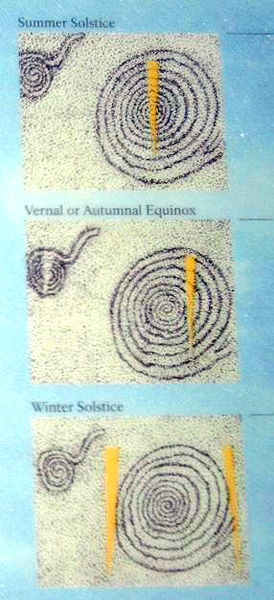
In the heart of New Mexico there is an arid canyon called Chaco Canyon that was once the center of the Anasazi culture.  In this canyon stands an ominous butte called Fajada (fa-ha-da) Butte.  Atop this huge 450 ft-high formation are three large sandstone slabs that lean up against the southern wall.  On the wall behind these huge stones, the Anasazi astronomers chiseled two large spirals.   At noon every day the sun shines between the stones and casts shaft(s) of light across the spirals.  Popularly called “daggers of light”, the dagger materialize before noon in the upper left of the spiral and then spread across the spiral to project a “dagger” covering the spiral and then clears off the spiral top to bottom.   It is an amazing, almost magical occurrence.
Click for video of Sun Dagger

The Sun Dagger phenomenon was first noticed by artist Anna Sofaer in 1977 when she was a volunteer recording the petroglyphs on Fajada Butte.  On her first visit, she noted the three stone slabs leaning against the cliff in front of two spiral petroglyphs on the cliff wall.  On her second visit, she happened to be at the site around 11 a.m. and witnessed the dagger of light bisecting one of the spirals.  An amazing stroke of luck since the dagger only appears for about 18 minutes each day.  Realizing that the summer solstice was imminent, she correctly recognized the site as an important archaeoastronomical site.

The following year,  she founded the “Solstice Project” to focus on the study, documentation and preservation of the Sun Dagger site.   Her team learned that for the spring equinox, two daggers appear.  A smaller dagger bisects a smaller spiral through its center, whereas the larger dagger pierces the larger spiral off center.  For the summer solstice, the larger spiral is bisected by a larger dagger through its center.  The autumn equinox is the same as the spring equinox.  Then for the winter solstice, two large daggers embrace the sides of the larger spiral like bookends.  Even more remarkable, it was observed that the 19 segments of the larger spiral marked the 19 year movement of the moon from minimum to maximum across the horizon.


At the Archaeoastronomical Symposium at Queen’s College, September, 1981, Anna Sofaer submitted a paper on her work .  It was the conclusion of the symposium that the Sundagger Site is the only known site in the world where both the solar and lunar extremes are marked.


For over one thousand years, the stone slabs produced a dagger of light to mark the solar extremes and marked the lunar shadow marching through its 19 year extremes.  Its rediscovery  generated so much interest that the many visitors eager to observe the site first-hand tramped down the soil next to the slabs prompting the site to be restricted and not even the park staff are allowed to visit the Sun Dagger site today.   Unfortunately, the damage was fatal and caused the slabs to shift.  As a result, the slabs no longer produce the daggers of light as they once did.  The restriction was placed too late to save it.
 

Thursday, November 8, 2012

Native American Skies -- The Pleiades

Last week I told a short version of the story of the  Ani Tsutsa, the Seven Boys, who got angry with their mothers and danced into the sky to become the constellation we know as the Pleiades.  Some have asked me why they were angry with their mothers.  So, here is the “rest of the story” as told to James Mooney, “Long ago, when the world was new, there were seven boys who used to spend all their time down by the townhouse playing the gatayu’ sti game, rolling a stone wheel along the ground and sliding a curved stick after it to strike.”
Game of Gatayu' sti
Painting by George Catlin

 
Gatayu’ sti, also known as Chunkey, was played with a stone disk about an inch thick and three inches in diameter.  The disk was rolled across the ground and the players would “chunk” long spears at it.  Closest got one point, hitting it gave two points.

“Their mothers scolded, but it did no good, so one day they collected some gatayu’ sti stones and boiled them in the pot with the corn for dinner.  When the boys came home hungry their mothers dipped out the stones and said, ‘Since you like the gatayu’ sti better than the cornfield, take the stones now for your dinner.”

This story had different versions in different tribes.  The following Iroquois story is from a wonderful book by Jean Guard Monroe and Ray A. Williamson called “They Dance in the Sky”, “One autumn many years ago, a band of Onandaga Iroquois were walking toward their winter hunting ground near a large lake in southeast Canada.  They had to travel slowly, because the land was wild and rough.  When they finally arrived at the place they called Beautiful Lake, they were very thankful because, as in years before, they found much game and fish there.  Clear water flowed from the many springs in the lovely valley nestled among the hills.

“Tracks-in-the-Water, the chief of the band, thanked the Great spirit for their safe arrival and for the abundance of wildlife.  “We will camp here for the winter,” he told his people.  “It will be a good winter.”  Everyone was happy.  They knew they would prosper in this peaceful valley by Beautiful Lake.

“Soon autumn ended and the weather turned colder.  Eight children from the band tired of helping their mothers and fathers in the daily chores and began to dance by the lake to amuse themselves.  They picked a quiet place away from the village.  Each day they met and danced for hours at a time.  Though they got hungry and lightheaded, they still danced on and on.

“For a long time everything went well.  Then one day, while the boys and girls were dancing, a glorious old man appeared to them.  He shone like silver in the late autumn sunshine and was covered from head to toe with a cloak of brilliant white feathers.  His gleaming hair was very long and white.  He was kindly, but he warned the children not to keep on dancing or something terrible would happen to them.

“The children didn’t want to hear his words; they continued to dance.  Each day, Bright Shining Old Man, as they called him, came and warned them, but the children ignored him.

“One day the children decided to take food along with them so they could stay out longer the next day.    They asked for food, but their parents refused.  “You must eat at home as usual.  Then you may go play.”  But they resolved to dance all day long just the same.  After a while, the children became hungry, and their hunger made them lightheaded.  Then slowly, little by little, they began to rise in the air.  Suddenly one youngster cried, “Don’t look down, something strange is going on.  We seem to be dancing on the air!”

“”What great fun!” thought the children.  At first they were excited and pleased, but soon dancing on air frightened them.  Now they couldn’t stop or they would fall to earth far below.  Bright Shining Old Man looked up, shaking his head.  He watched them rise farther and farther up into Sky Country.

“”If only they had listened to me,” Bright Shining Old Man thought sadly.
 
The Pleiades Constellation
Ani Tsutsa to the Cherokee
Oot-kwa-tah to the Iroquois
“Soon an old woman in the village noticed that that the boys and girls were floating away.  She called and called for them to come back, but they did not stop dancing.  Then the whole band gathered below and tried to call the children back, but to no avail.

“All this time the children kept on dancing faster and faster.  They did not look down.  One small boy recognized his father’s voice above the others.  The chief, Tracks-in-the-Water, called loudly to his son, “Come back, come back!”  The boy looked down and saw his father.  At once he became a falling star.  The other children just kept floating up, up, far into the sky.  The Onandaga call them Oot-kwa-tah.

“Now whenever the Onondaga Iroquois see a falling star, they are reminded of Oot-kwa-tah, the band of headstrong dancing children.”


Thursday, November 1, 2012

Native American Skies -- Cherokee, What the Stars are Made Of


Pleiades Constellation
Cherokee called it Ani Tsutsa
When the Cherokee looked up at the dark moonless skies, they saw billions of spirit campfires.  Like today, they also saw patterns in the stars and told stories about the constellations.   The constellation that we call the “Pleiades”, the Cherokee called “Ani Tsutsa”, or the “Seven Boys”.   The story goes that eight young boys got so angry with their mothers that they prayed to the spirits to lift them into the sky.  They danced around the Council House until they started to rise up off the ground.  One of the mothers managed to grab the foot of their son and pull him back down, but the other seven floated up into the sky and you can see their bright campfires at night.

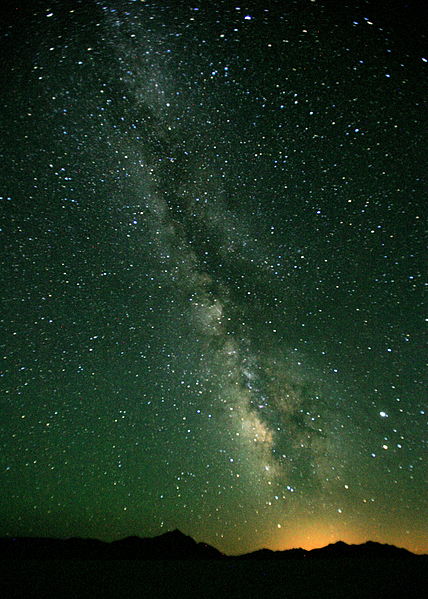
The milkyway, according to old Cherokee stories, was created long ago when the earth was young and there were not many stars in the sky.  The people made corn meal from dried corn and stored it in large baskets.  One morning an old man and his wife discovered that something or someone had gotten into the cornmeal during the night.  In the middle of the spilt meal were giant dog prints.  They were so large that the Elders decided that the dog must be a spirit dog from another world.  They did not want the spirit dog in their village, so they decided to frighten it so bad it would never return.  They put on their turtle shell rattles, got their drums and hid by the corn meal baskets.   Late that night they heard a great whispering noise like many birds flapping their wings and looked up to see a giant spirit dog swooping down to land by the baskets.  When it began to gulp down mouthfuls of cornmeal, they jumped up and made a great noise like thunder.  The giant dog ran across the night sky and the cornmeal that spilled from its mouth turned into the stars of the Milky Way.

Some Cherokee had different opinions about the stars according to James Mooney’s Myths of the Cherokee.  He wrote, “Some say they are balls of light, others say they are human, but most people say they are living creatures covered with luminous fur or feathers.  One night a hunting party camping in the mountains noticed two lights like large stars moving along the top of a distant ridge. They wondered and watched until the light disappeared on the other side. The next night, and the next, they saw the lights again moving along the ridge, and after talking over the matter decided to go on the morrow and try to learn the cause. In the morning they started out and went until they came to the ridge, where, after searching some time, they found two strange creatures about so large (making a circle with outstretched arms), with round bodies covered with fine fur or downy feathers, from which small heads stuck out like the heads of terrapins. As the breeze played upon these feathers showers of sparks flew out.  The hunters carried the strange creatures back to the camp, intending to take them home to the settlements on their return. They kept them several days and noticed that every night they would grow bright and shine like great stars, although by day they were only balls of gray fur, except when the wind stirred and made the sparks fly out. They kept very quiet, and no one thought of their trying to escape, when, on the seventh night, they suddenly rose from the ground like balls of fire and were soon above the tops of the trees. Higher and higher they went, while the wondering hunters watched, until at last they were only two bright points of light in the dark sky, and then the hunters knew that they were stars.”

The Cherokee also had an alternative explanation for meteorites or falling stars.  Again from “Myths of the Cherokee”, “At night, when some one is sick or dying in the settlement, the Raven Mocker [a witch] goes to the place to take the life. He flies through the air in fiery shape, with arms outstretched like wings, and sparks trailing behind, and a rushing sound like the noise of a strong wind. Every little while as he flies he makes a cry like the cry of a raven when it "dives" in the air--not like the common raven cry--and those who hear are afraid, because they know that some man's life will soon go out. When the Raven Mocker comes to the house he finds others of his kind waiting there, and unless there is a doctor on guard who knows how to drive them away they go inside, all invisible, and frighten and torment the sick man until they kill him.”

All peoples and cultures have been fascinated by the beautiful night sky.  And occasionally they see something really special like the Super Nova of 1054.  The Anasazi recorded this extraordinary event in a petroglyph in Chaco Canyon.

-- Courtney Miller

Thursday, October 25, 2012

Inconvenient Arrogance, Part 6 – The Collapse of the Chaco Phenomenon


Great Kiva - Pueblo Bonito
“It is not hard to imagine one of these ancient villages—the adults going about their tasks, the children playing or learning at their side.  We can almost smell the rabbit stew cooking in the earthen pot and the aroma of corn roasting over the coals of the cookfire;  we can almost see the freshmade paper-thin piki bread—all this in anticipation of the day’s-endmeal after the men have returned from attending to the fields or building a new village structure.” – Kendrick Frazier, “People of Chaco”.


Life among the Anasazi was hard but they were a rugged and industrious people who by the twelfth century had created great stone houses and temples and created governments that organized and distributed their commodities and coordinated trade.  Although the most prominent and powerful, the Chaco culture was not alone in the Southwest.  In Arizona, the Hohokam society built smaller stone houses and made extensive use of canals for farming.   East of the Hohokam, the Mogollon society had a similar culture.  In between Chaco and Hohokam and Mogollon, a hybrid society that borrowed canal technology  from the hohokum and architecture from Chaco were called the Mimbres.  During the classic period, trade was pervasive among these different cultures.

Penaco Blanco -- Chaco Canyon
Road that defines Chaco Meridian

So, what happened to Chaco Canyon?  Why was it vacated by A.D. 1170?  Evidence shows that climate change resulting in long periods of drought is at the root of the cause.  Long before, Chaco Canyon had become over populated and unable to sustain itself without the aid of the outliers.  The luxury of being the central storehouse for the region and in control of distribution allowed them to skim off the extra they needed.  Since corn could only be stored for three years, however, any drought lasting longer than three years depleted the store houses and left Chaco Canyon unable to sustain itself or redistribute to outliers needing help.  This made the outliers unwilling to share their surpluses with Chaco Canyon and hoard their crops for themselves.  The collapse was amazingly swift.

Where did they go?  Jared Diamond proposes, “By analogy with historically witnessed abandonments of other pueblos during a drought in the 1670-‘s, probably many people starved to death, some people killed each other, and survivors fled to other settled areas in the Southwest.”

But, unlike the Maya and the Moche, the rulers of Chaco did not resort to human sacrifice to stave off their demise.  There are several reasons that they never rose to this level of cruelty.  The lace of a large centrally controlled military made enforcement from Chaco impossible.  There are signs that there were violent skirmishes at outlier sites, but not on the scale that would suggest a large military invasion.

Stephen Lekson offers a unique  alternative.  In his book, “The Chaco Meridian”, Lekson suggests, “The end of Chaco was a major event over the entire Pueblo world.  Far to the south, for example, the Mimbres achievement ended at the same time. … The Chaco capital moved to the north …”  The Chaco elite, according to Lekson, re-established the Chaco system along the Las Animas river at the site called Aztec.  Again from Lekson, “Aztec continued the traditions and forms of Chaco, but ruled a diminished realm …”

What is unique about the Lekson hypothesis is that Aztec lies along the meridian that intersects with Chaco and a road follows that meridian from Chaco to Aztec.  Even more remarkable, after the fall of Aztec in A.D. 1275, “The Elite moved completely off the Plateau, through the vacant despoiled Mimbres country and into an empty niche, ripe for major canal irrigation.  They built their new city, Paquime, on the Rio Casas Grandes.” 
 
Which, remarkably, lies along the same meridian!

Thursday, October 18, 2012

Inconvenient Arrogance, Part 5: The Chaco Phenomenon

Pueblo Bonito -- Chaco Canyon
from the rim
When the current Southwestern cultures reach back in their lore to their origins and refer to the “White House”-- “places of wonder and tragedy”, they are probably referring to the great pueblo houses at Chaco Canyon.  Pueblo Bonito, the largest of the “Great Houses” was five-stories high, covered over two acres, contained over 650 rooms, 45 small kivas and two “Great Kivas”.  Kivas were large, round pits or chambers used for religious and ceremonial events.

Stephen Lekson, who has studied the Anasazi phenomenon for over twenty years, described Chaco Canyon this way in a recent article for National Geographic, "Imagine that you're a teenage kid in the 11th century, coming from the boondocks to Chaco for the first time.  You've walked four days from the north across that desolate plain to get here and you look over the edge . . . what would you think?  It would scare the hell out of you … They planned it that way—as theater."
Great Kiva at Chetro Ketl
Note: hidden chamber in back enabled underground
passage to center of kiva for theatrical entrances

Within its thirty-two square miles, there were thirteen of these great houses!  If you have ever driven through the heart of New Mexico, which is where Chaco Canyon resides, you have to admire the raw beauty of the arid lands.  But it is hard to imagine that anyone could etch out a living there.  Even today, houses are few and far between.  But in its heyday, it was estimated that over 5,000 lived in Chaco Canyon.

I think that the harsh conditions may have contributed to the extraordinary achievements because in order to survive they had to be extraordinarily creative and resolute.   But why build there in the first place?  Initially, it was a favorable location for that part of New Mexico since the narrow canyon caught rain runoff from the upland areas surrounding it.  This enabled the farmers in the canyon to capture water even when it didn’t rain directly on the canyon.  The soil was also quite fertile from the runoff.  The inventive residents learned to build dams and channels to capture, hold, and direct the water and, as a result, the “Chaco Wash” was able to support a much larger population than surrounding areas.

I have saved the Anasazi for last not only because the great Anasazi culture rose up after the Moche and Maya empires collapsed, but also because it seems to have avoided the extremes of the previous two cultures.  The cataclysmic event of 536 A.D. and the harsh climate that followed had begun its swing back when the Chaco Culture began to flourish and start building their unique version of large stone buildings around A.D. 700.  As the population grew, there developed a need for organization and government.

Again quoting Stephen H. Lekson, from his book “The Chaco Meridian”, “Chaco had begun about 900 [A.D.] as three villages competing, in a circumscribed canyon, for agricultural land and labor.  Those local energies spilled out of the canyon, engaging and entangling allies from around the agriculturally rich rim of the Chaco Basin.  By 1020 [A.D.] Chaco had emerged as a small but important central place.  Variable rainfall meant that a good year in the north might be a disaster in the south; Chaco’s serendipitous middle place promoted its rise as a kind of regional “capital” – a place to store and exchange commodities and a “corn bank” to even out the agricultural variability of the Chaco Basin.  Canyon leaders administered redistribution and real political power, based on garnered surpluses, developed within the canyon.  Population centers around the Chaco Basin became Chocoan “outliers”.”

And although the population within the canyon had long since outgrown the canyon’s agricultural capabilities, it was subsidized by the outliers pouring their surpluses into the “capital” across regional networks of roads visible from the air even today stretching from over 200 miles to the south, 200 miles to the north, 200 miles to the west, and over 100 miles to the east. 
 
Note: in picture [above] the scar from the road that connected Chaco Canyon to northern outliers can still be seen (left and abovef the ruin).

But, the empire proved to be very fragile.  Due to the nature of corn, it can only be stored for three years before it becomes too rotten or infested to eat.  Therefore, a severe drought lasting longer than three years could deplete corn supplies.  That fatal event happened around A.D. 1130 according to tree ring dating.   Unable to support itself and reliant on the outliers for food, the empire began to collapse as, according to Jared Diamond in his book “Collapse”, “… the outlying settlements that had formerly supplied the Chaco political and religious centers with food lost faith in the Chacoan priests whose prayers for rain remained unanswered, and they refused to make more food deliveries.”

There is evidence of intense warfare throughout the Chacoan empire.  But, unlike the desperate measures taken by the Mayan and Moche leaders and priests, there is no evidence that the Chaco elite resorted to human sacrifices.  Construction in Chaco had completely ceased by A.D. 1170 and the great houses were empty.  What happened to the people of Chaco Canyon?  More on that in the next installment of “Inconvenient Arrogance”.

-- Courtney Miller